
Sixth Month
Notes from the 181st day of motherhood.

This collection of notes is part of a series I am writing month-by-month, recording the early stages of motherhood. Click here to read ‘First Month’, ‘Second Month’, ‘Third Month,’ ‘Fourth Month,’ and ‘Fifth Month.’
My second novel, Elegy, Southwest, recently won the 2026 Australian Literature Society ALS Gold Medal. You can buy the novel here (US), here (UK), and here (AU).
Mathilde and I sit outside a café with the baby, then take her on a walk, eating ice cream. I direct us to the cemetery in Soldiner Kiez because it’s shady in there, and very pretty. As we walk around the cemetery, I realise that, aside from mourners, the only other people in the cemetery have babies in carriers and prams. We’re all walking in circles at a slow pace, keeping them in motion to keep them quiet. At the far end of the cemetery, we find that somebody has erected a Mongolian yurt. There’s a sign explaining all the design elements of a Mongolian yurt. But no sign explaining what it’s doing in the cemetery.
When the baby is finished drinking for the night, as I lift her up to give her a cuddle, she makes a sudden movement. She turns her face to my cheek with great purpose, opens her mouth, presses it against my skin, and gives me a kind of lick. Then she does it again, and again. I start giggling. They are kisses. I am laughing but I’m also on the verge of tears. “My daughter gave me a kiss” I say to V, like it’s the most surprising, wonderful thing that could have happened. She lick-kisses me until my cheek is completely soaked in her spit, and I at last decide that it’s time for bed.
V goes to London because he’s won the McKitterick Prize. It’s the longest that I’ve looked after the baby completely on my own. It’s also the first day of the heatwave. By midmorning the heat has infiltrated the whole apartment. I take the fan out of the wardrobe and unscrew it to wipe it down, eons of caked black dust on the blades and mesh - we’ve had it six years and I hadn’t thought to clean it until now. The bedroom thermometer I bought before she was born says our bedroom is 29 degrees (84.2 F). It’s the coolest room in the apartment. I lay her beside me on the bed and we spend all afternoon in the dark bedroom under the path of the fan.
We hear the thunder as we’re walking home from the pool. We wait for iced coffees outside Café Dreizehn watching the bruise-coloured sky, and by the time we’re at the door to our building the wind is moving in dramatic gusts and flinging semen-scented linden blossoms into our eyes. The thick white sheets of rain start once we’re home, and the three of us sit on the floor of the writing room drinking our coffees and watching the storm together.
It takes me longer to express myself since birth. I have a thought, and it takes me a long beat, maybe 30 seconds, to vocalise it. I lose phrases and concepts — ‘trampoline,’ ‘augury,’ ‘O-Week.’ V says I am becoming slower to form sentences. I remember my ex-husband saying, after my first semester at Columbia, that I’d gotten much better at telling anecdotes. How pleased I had felt at my new aptitude! Where has it all gone now?
FaceTime with my mother in the morning. She asks if I’ve heard the news. I don’t know what she’s talking about, but she’s looking at me meaningfully. She tells me that a woman in Germany was taking groceries upstairs and left her baby in the pram at the bottom of the staircase. When she came back down, the baby was gone. A day later they found the baby’s body, murdered, in a field or bit of forest, she can’t remember. She says it happened maybe not in Berlin, but near Berlin. “Never leave the baby downstairs when you’re carrying shopping up,” she warns, “always take the baby up first.”
“I do,” I say.
“You never know,” she replies.
We take the baby to swim at Flughafensee in the afternoon. She’s overcome with the floaty quality of my hair in the water. She can’t keep her hands out of it. She looks at me enraptured. Afterwards, as we sit on the sand, I joke to V that lately it’s like being adored by a particularly enthusiastic teenage boy — she’s always wanting to put her fingers in my mouth, squeeze my breasts, bury her hands in my hair, caress my chin, stare into my eyes, kiss-lick my face all over.
The train to Paris. Up at 5am, and already beads of sweat are rolling down the backs of my legs. The train is hot, but the temperature is manageable with the small green fan I’ve brought along and propped in front of us on the table. We are meant to get into Paris just before 3pm, but outside Strasbourg we come to a stop in a field. They announce that there’s the embankment up ahead has caught fire, they need to wait for firefighters to put it out. They tell us to close the blinds on all the windows. They’re already giving out free water in the dining car. Later, we’re told that the whole train line between Strasbourg and Paris is closed, no trains are allowed in or out, and they’ve no idea how long we will sit here. Worried murmurings. I begin to panic, wondering about how long the feeble air conditioning can hold out under the pounding sun, how much water they have on the train, how long we will all sit here. But the baby is fine. She’s having a lovely time! In the end we get into Paris closer to 6pm. At the Gare du Nord the heat hits in a thick wave, the kind that reminds me of summers in Phoenix, or Darwin. We manage to get a cab outside the station and load the car seat in, the panic abating once we’re in the climate-controlled safety of the cab. We order Cambodian food to the air-conditioned Ibis we’re staying in. V, mispronouncing one of the meals on the menu, says he might like the “bonbon thing.” The baby, sitting on my lap, begins to laugh. “Bonbon,” I say, and she giggles again. For ten minutes we sit there saying “bonbon” to her as she giggles and giggles. It’s the longest and most raucously she’s ever laughed. But then the spell breaks, and suddenly “bonbon” elicits no reaction. We try again later, but it’s gone.
We’re awake at 5am to watch the last half of Australia playing Paraguay, and afterwards set out into the early morning. We get croissants and coffee, and walk over the Seine to the Jardin des Plantes. We fetch the baby out of her pram a minute and let her pat the roses. By 8.45am it’s too hot, and we’re back at the hotel. We stay inside all day, leaving only to get lunch around the corner. I think about this Paris trip in the context of all the other trips I’ve ever made to Paris. When I was sixteen, and bought cigarettes for the first time and smoked them with Sophie by the Seine. When I was eighteen, with bedbug bites and no money. At twenty-nine, months before my first marriage fell apart. Here with V on honeymoon in 2023, when he got food poisoning. In the autumn of 2024, when we first started “trying.”


Last year, when I was only five weeks pregnant, we passed through Paris on our way south, and V said, walking through the 11th, “we’ll never be able to just go to Paris on a whim ever again.” Now here we are in this heatwave with a baby, hiding from the city in a hotel room. In the evening, we order Korean food and watch French news items about the cannicule, about the mass deaths of chickens and cows, the hospitals overcrowded, the drownings, and when is it going to end?
All the trains are delayed at Gare de Lyon, a whole atrium of waiting passengers fanning themselves with hats and paper tickets and cheap souvenir fans. This French train is much smaller than yesterday’s German one, and we have only two seats instead of three. A couple sits across from us, American, early twenties, the girl reading The Hunchback of Notre Dame. The man in a white singlet, takes up the shared table with his laptop. I hear him telling her about how “his soul” feels when he’s surfing. The baby complains when I try to feed her. The train is too hot, she doesn’t have enough room across my lap to kick and stretch out as she drinks. The panic and shame I feel when she cries when I try to breastfeed her in public, calling attention to us, as though I don’t know what I’m doing. The worry that I don’t, in fact, know what I’m doing.
My mother-in-law picks us up from Avignon. I sit in the back with the baby. As we drive to her house she asks if we’ve heard about the children who’ve died in hot cars during the heatwave. She details them all. The same thing happened to a little boy about twenty years ago in Neutral Bay in the summertime, she says. The father was meant to take the little boy to daycare but forgot about him, drove to work not remembering he was still in the backseat, left the boy locked in the back of the car, discovered him dead upon his return. That’s what happens if you’re not paying attention.
Orange and red temperature warnings. Endless days of cloudless skies, 37, 38, 39 degrees. The heat of my mother-in-law’s house is infernal, at night it’s hotter inside than out. We have two fans on in the bedroom, blowing hot air back and forth over our three bodies. Breastfeeding is awful, all that sticky warmth between the baby’s body and mine. The baby wants to feed sometimes for over an hour, ten or eleven times a day rather than six. I am exhausted and starving, emerging into the kitchen like a raccoon to scavenge what I can. We stay downstairs, keep the blinds shut. I did not expect this, the annihilation of any kind of anticipated ‘holiday’ to breastfeeding. I am milk-stained and sweaty and up late, after everyone else is asleep, pumping. In the first months I could watch TV with the sound on while I fed the baby, but now I can’t do anything for long without her turning her head away from the nipple to have a look. Unless I’ve queued up something to listen to on my headphones, I simply stare at the walls. My mother-in-law talks often about how she had to do just this sort of thing in India, only with three children, and no help, and no fans, in fact sometimes with no running water. “You just do what you have to do,” she says.
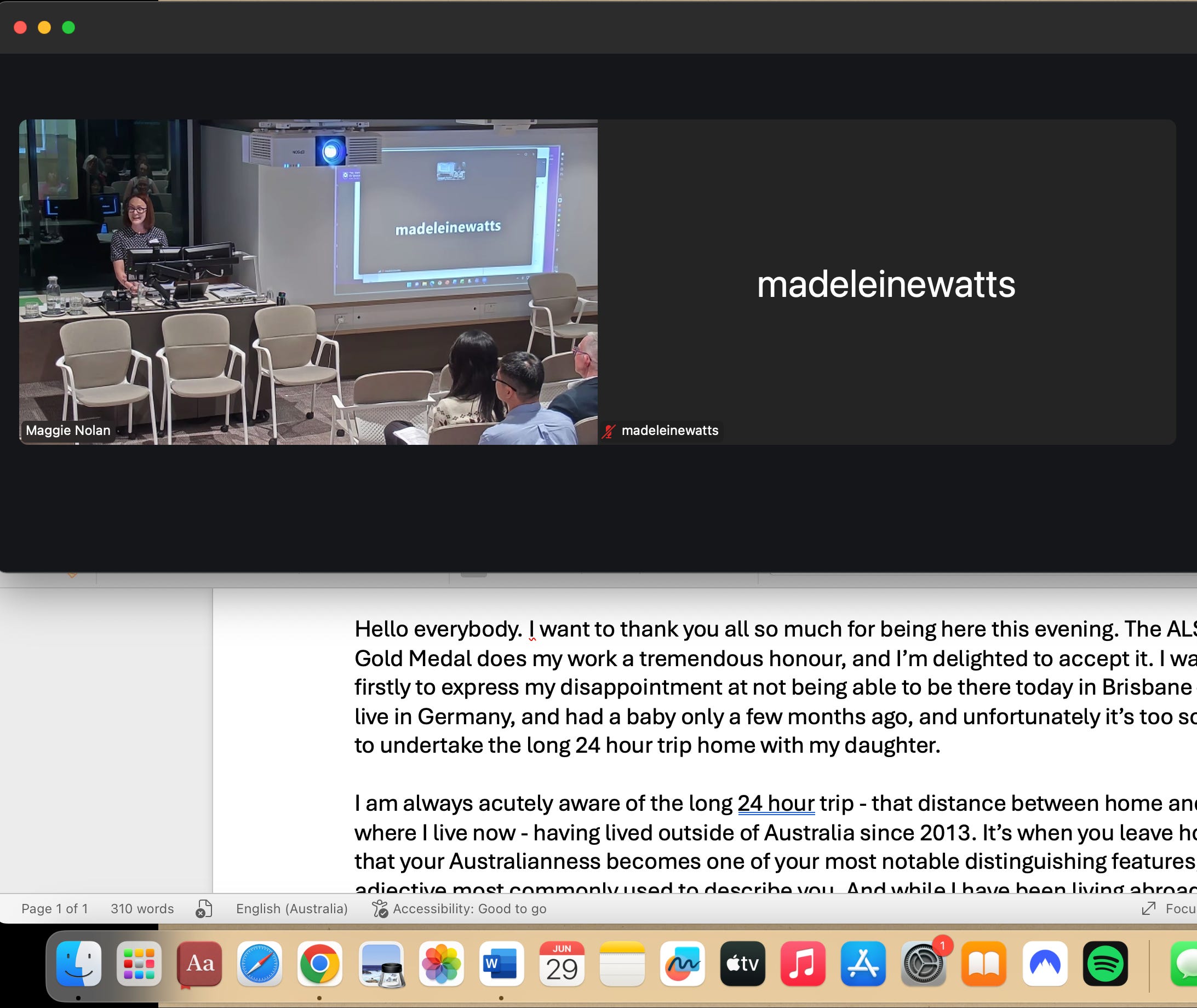
Monday morning I feed the baby and then put makeup on and pad barefoot down to the room where my mother-in-law does her drawing and I set up a desk on her trestle table and at 9.30am I’m on a Zoom call to receive my medal. The room is hot. They have me turn my camera off because “it’s meant to be a surprise” and I sit there trying to fan myself with my hands. When they turn their video on for me, I can see the podium and the projection screen, which is displaying, I can see, a huge Zoom window with the word “madeleinewatts” written in white across the black box. So much for the surprise. My name sits there on the screen for the entire 45 minutes of the ceremony, until they ask me to turn my camera on. I see my medal, it’s been brought to the ceremony even though I can’t be there to receive it. I can see some people in the front row clap, but I can’t hear any applause – the software filters it out. I deliver my remarks unsure if anybody can hear me, half my screen a Word document and the other the Zoom window of the podium in Brisbane. When it’s over I go into the kitchen, pour a glass of water. And then V and his mum return with the baby from walking around the cathedral, and I recommence breastfeeding.
On our first morning here, as I was loading the pram into the boot of the car, a wasp stung me on my forearm. This afternoon, we discover a wasp’s nest inside the lid to the boot. I rush the baby back into the house, V gets a broom, and my mother-in-law gets bug spray, and when they come back they say the wasps are gone. But when we return, V sees a wasp wiggle into the boot again. A few days later, we find a new wasp’s nest in the right-side passenger door. It is beautiful, perfectly round, honeycombed.
My mother-in-law takes the baby for a few hours in the late afternoon so that we can have a drink in the square to celebrate our wedding anniversary. We go to a wine bar and order the most expensive rosé they have by the glass, and talk. Amongst other things, we talk about what we would do if the other died; I say I would be a widow the rest of my life, and V says he would be too. I scoff, “No you wouldn’t.” We totter back to find the baby asleep in my mother-in-law’s lap. They are listening to Sibelius, and they are both wearing different outfits. The baby did an enormous poo all over the two of them, my mother-in-law says, looking slightly shell-shocked.
She has grown fascinated by her feet. Crawling up in a ball almost like she’s a newborn again, to bring them to her mouth, caress her own toes with her little fingers.
I ask for an hour to myself and walk in the blazing sun to the town pool. Built in the 1960s, it is shabby and perfect and bizarrely unpeopled. Do the French not swim? I stow my things on the painted white concrete steps, exactly like the kind I used to sit on at Ashfield Pool as a child, and which have since been renovated out of existence. I swim a kilometre, and the powerful magic of the process takes hold; I forget myself, forget everything, experience simply the one-two-three of breath and the drift of my thoughts. When I’m done, I climb the steps so that I have a view of Roman ruins and cypress pines and stone houses with bright blue unused pools, and sit drying in the sun. The town pool reminds me powerfully of places I’ve swum in southern California. I put headphones in and queue up the Yo La Tengo album Painful, an album which evokes the summer of 2015, California. For the hour and a quarter I have to swim and sit in the sun and listen to Yo La Tengo I am restored to a previous, younger version of myself, a self I feel profoundly distanced from. It is the happiest and freest I feel all month.


V shakes me awake in the middle of the night, repeating my name. The baby stirs. I had been screaming the word “help” in my sleep. I’d been dreaming. I remember that I’d been swimming laps in the town pool, and that as I had turned, I passed a man, his body suspended, floating face-down in the water. Swim cap, middle aged, nobody I recognised. I stopped, tried to stir him. But suddenly his body became a dead weight. The force of him, it was dragging me down into the water. And that’s when I started calling out for help.
The baby’s skin has gotten so red and patchy since the heat began, since we arrived in France, that we determine she needs medical attention. We take her to the pharmacist and show the woman behind the counter her shoulders and arms. She shrugs and nods, “Oui, c’est champignons.” The French word for ‘mushrooms,’ it turns out, is the same word you use for a fungal infection.
We take the baby to see a friend of my mother-in-law’s. When he claps eyes on her, he says “Ah, I wondered what she would look like. Because you’re quite fair, aren’t you (meaning me). But she’s just about in-between the two of you, isn’t she?” It is such a small comment, almost innocuous, but it bothers me all afternoon. Since she was born people have made comments to me about my daughter’s skin, often when V isn’t there. They range from, “she has a lovely skin,” to “do you think she looks very Indian?” Her skin has, I realise now, been remarked upon more times than any of other of her other features, more than her huge dark eyes, her long feet, her lovely round pink cheeks.
Another night of vivid dreams and fitful, too-hot sleep. In one, the baby is speaking in cogent sentences. I wake to a memory of her clearly articulating the word “relationship.”
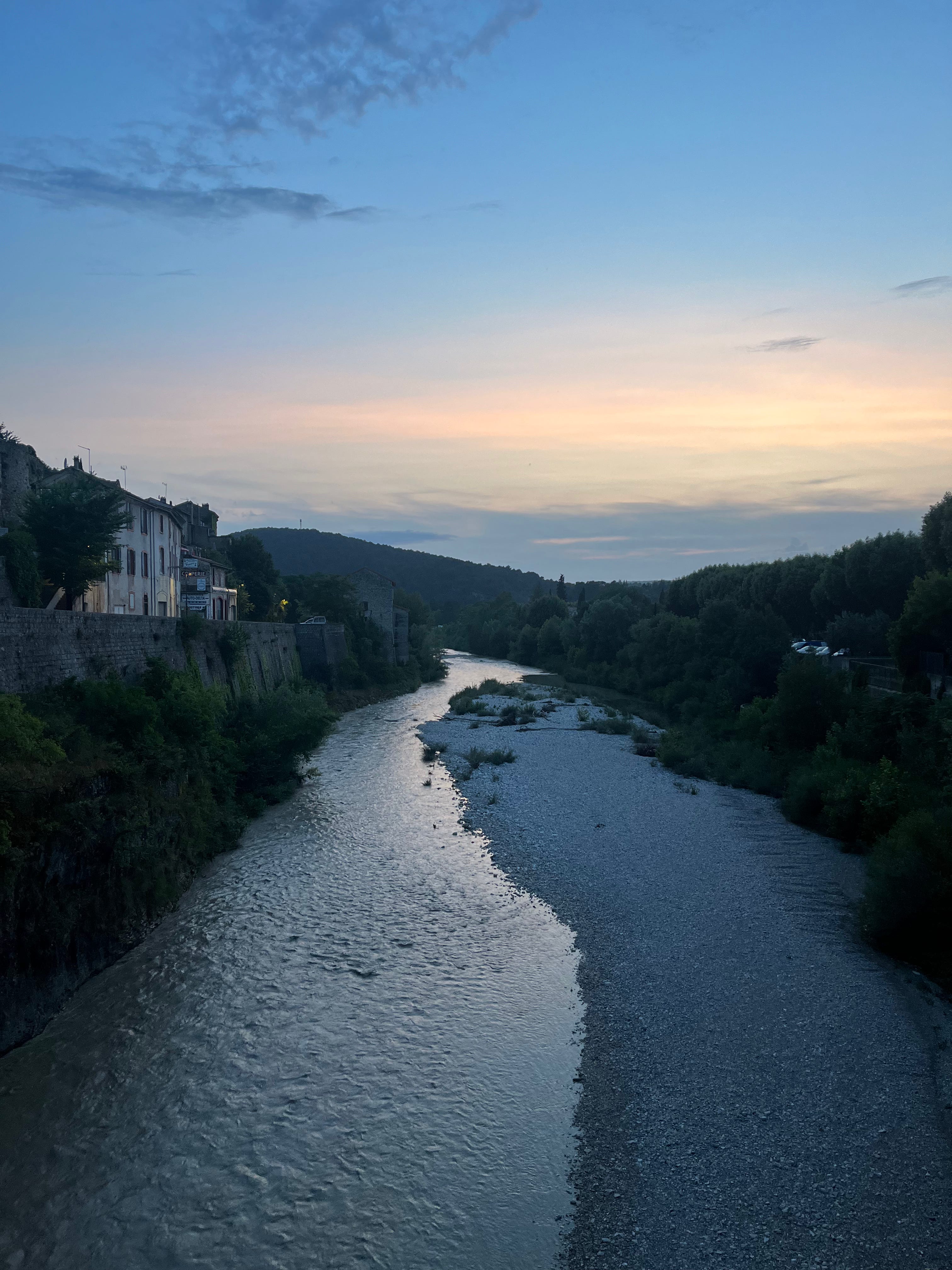
My mother-in-law says that we will soon have to stop telling the baby “You are a lovely one,” and “You’re the loveliest baby that ever there was.” Because one day she will start school, and then we risk her telling people that she is the loveliest child.
Tonight, V finds me with my head in my hands as she screams for reasons unknown, my breast slumped out of the nursing bra, and I say I’m having trouble taking it. The heat, the claustrophobia, the constant breastfeeding. Texting with Laurel, I tell her it’s like “a reverse blizzard.” The extremity of the weather means we must constantly shelter inside, leaving only when absolutely necessary.
On Wednesday I get two hours in the afternoon to write, while V and his mother look after the baby. It’s the first real time I’ve had to write in over three weeks. An hour in, I make the mistake of looking at my phone on my way to the bathroom. I have an email from my former best friend. She heard I had a baby, offers congratulations, says she read something I wrote about it. It’s the first communication between us in two and a half years, when I emailed to congratulate her after having heard she had a baby. I am so startled by her name on the screen that I drop my phone.
When the baby is at last asleep V pours himself a beer and I bring a block of chocolate up to the bedroom, and we watch France play Morocco on his laptop. The room still feels like a furnace. When I at last reach for a piece of chocolate, I find that it’s gone soft and floppy, and by half time the entire block of chocolate has melted. I drag a finger through. I am shocked. V shrugs. “We’re from Australia,” he reminds me, “that always used to happen.” I guess it did, I do remember chocolate melting, of course I do. Has a decade of American air conditioning made me so weak?
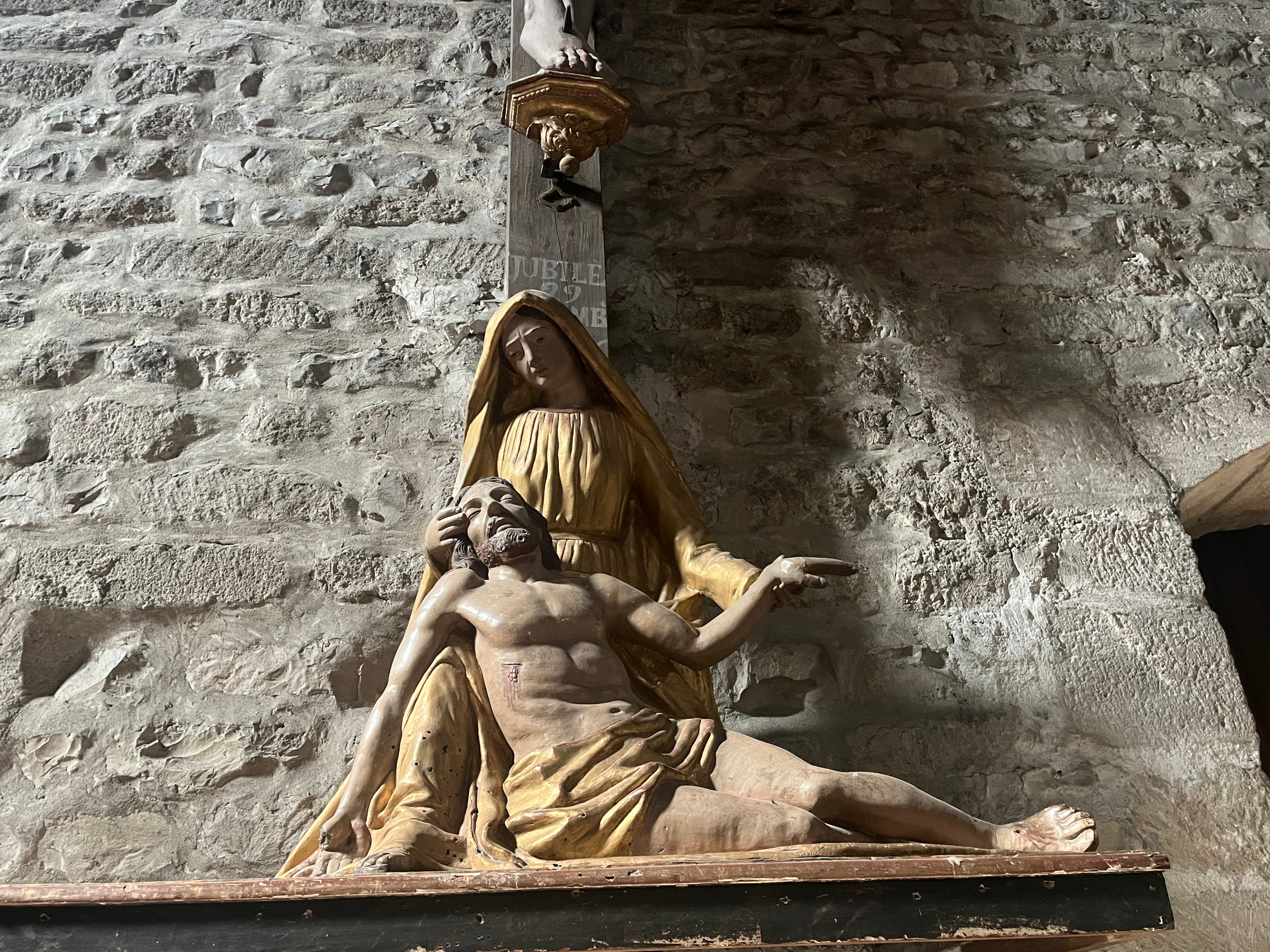
In the afternoon I put the baby bath out in the garden and fill it with cold water from the hose and put her in to play. Sense memory of childhood: the smell of hose water on hot concrete and baking shrubs. The Mistral has been blowing; somewhere, I can smell fire. My mother-in-law comes out and sits in the chair and watches, besotted with the baby. While we observe her splashes, my mother-in-law tells a series of stories. One about the former British conservative minister Jeremy Hunt, whose baby sister had drowned in the bath when their mother left to answer the telephone. Then a story about a party she’d once been attended in Sydney, where some children had pushed a chair up to the pool fence and climbed over it without any adults noticing, and drowned. And then about her friend’s three-year-old daughter slipping under the water as she played on the sand at Balmoral Beach before they noticed and rescued her. They can drown so quickly, just like that. I’m holding the baby tight in the water. “I’ve always been afraid of water,” she says.
I qualify: “Water in general, or children around water?”
“Children,” she says.
During the second bedtime feed she needs tonight the baby becomes distracted, stops drinking, and notices the black bra strap on my shoulder. She starts fondling it, trying to get her hand around it. V is sitting beside me watching Spain play Belgium, and looks over to see what she’s doing. “A woman after my own heart,” he says.
Bliss to be back in a clement climate, to walk without feeling the beating danger of the sun, taking the cloth cover off the pram so that the baby can see the world. She is wide eyed looking at all the trees in Prenzlauer Berg, like she’d forgotten what trees were.
Dinner at Saskia’s. I ask if there’s a place where I can feed the baby and Saskia leads me into her bedroom where there’s a big plush brown swivel chair she says her boyfriend just built, so I feed the baby there out of sight of the other guests. I can still hear the flow of conversation, but I am only half-listening, trying not to get breast milk on the special chair, gazing out the window into the courtyard. The baby rips out a chunk of my hair in her enthusiasm, and breaks away from drinking when she hears a wave of laughter from the other room. She smiles at me like we’re both in on the joke, and keeps drinking.