
Fifth Month
Notes from the 151st day of motherhood.

This collection of notes is part of a series I am writing month-by-month, recording the early stages of motherhood. Click here to read ‘First Month’, ‘Second Month’, ‘Third Month,’ and ‘Fourth Month.’
My second novel, Elegy, Southwest, has recently been longlisted for the Miles Franklin Literary Award and shortlisted for the Australian Literature Society ALS Gold Medal. You can buy the novel here (US), here (UK), and here (AU).
Every morning, V takes the baby on “a survey of your domain.” I hear him talking to her from the bedroom as he carries her from room to room. “Here we have the writing room, which has some nice plants in it and some books. Here is the hallway - it’s what we call a communicating room. Here’s the living room, looking pretty tidy because Madeleine tidied it yesterday. And here is a cactus, we always have to be very careful of the cactus.” On it goes, until each part of the apartment has been visited and narrated.
V is washing the dishes. I lean against the doorframe, and say that it has occurred to me lately - and I don’t mean to alarm him - that now she is here, I can’t ever kill myself. It’s not an option anymore. He nods, and says he has thought the same thing. “I think every new parent probably has that thought,” he says.
We take her to the Australian embassy to apply for her passport, and afterwards we go to a cafe with outdoor seating and I try to feed her, pulling the sleeve of my dress down. But she’s distracted. There’s a man who has a tiny chihuahua and three woolly poodles in three different shades of brown. She is fascinated by them, and the man pouring water for the dogs outside the späti loves being the subject of her attention, shows off for her – “look, nice dogs!” But she is just as entranced by the huge yellow skip bins being rolled down to the street from a neighbouring courtyard.
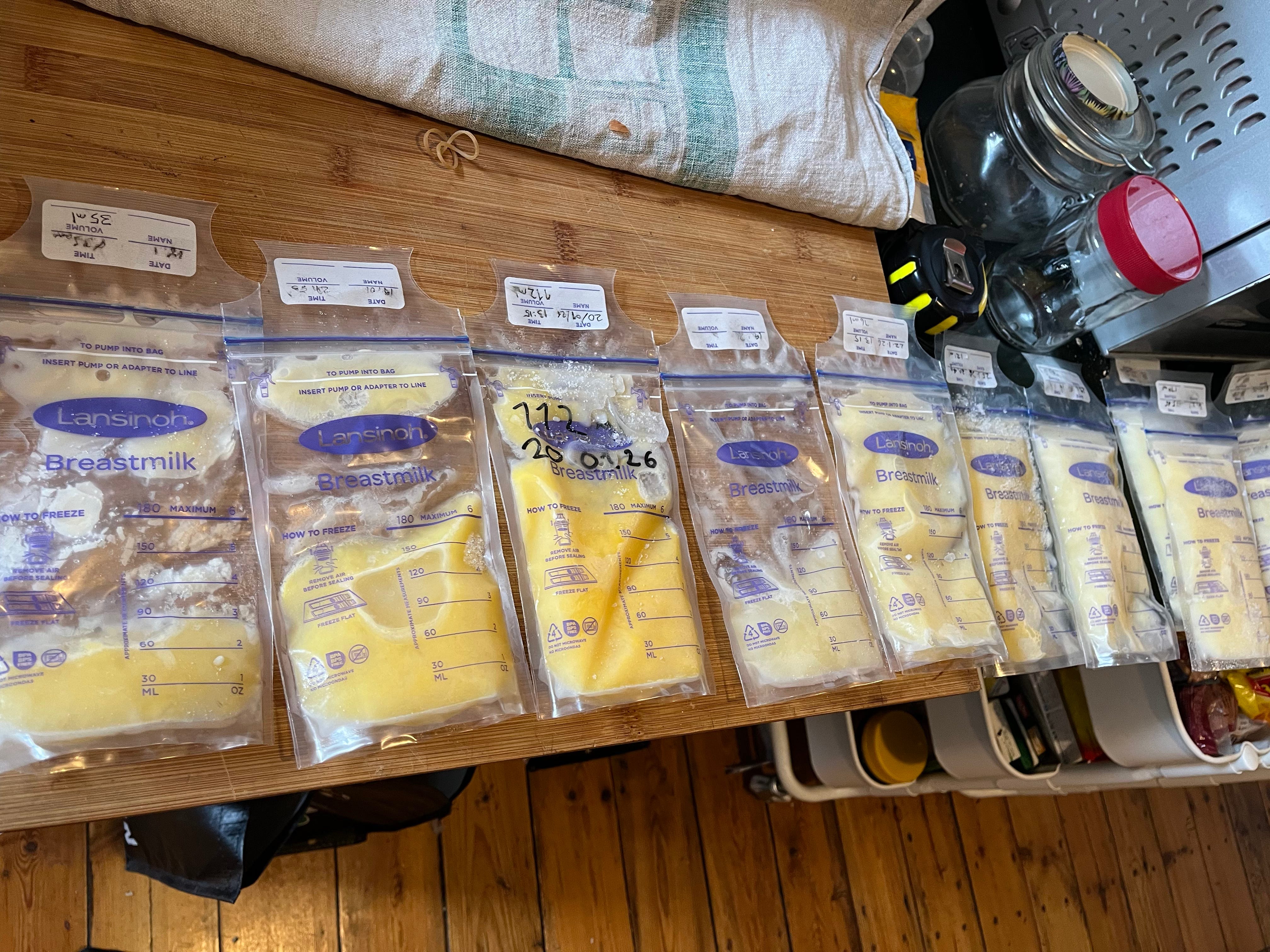
In the afternoon I go through the freezer, and I collect all the frozen breastmilk pouches from January and February. They are too old now; she probably wouldn’t even drink this milk if we tried to use it. I line up all the pouches on the counter by date. It’s a kind of marvel. The thick, dark yellow almost custardy quality of the milk from the first days. The way it lightened, grew thinner and more plentiful as the weeks elapsed. I photograph the milk, this thing that I have made with my body, and then I dump it all in the bin.
The way she looks at the green of the trees! The awe and wonder on her face when I take the hood down on the bassinet and she has a clear view of the canopy above her. Taking her out of the pram by Plötzensee she throws her hands in the air and makes a gurgling sound of wonder and delight, taking in all the greenery and the stretch of lake ahead of us, much as she does when we’re walking with her unclothed towards the bathroom and she realises she’s about to have a bath.
A couple get on the U9 at Nauener Platz, one with a baby and one with a toddler. The woman with the baby wears a t shirt with a logo in the corner reading ‘MUM Est 2025.’ The man with the toddler wears a t-shirt bearing an artfully hand stitched logo reading ‘Tired Dad’s Club.’
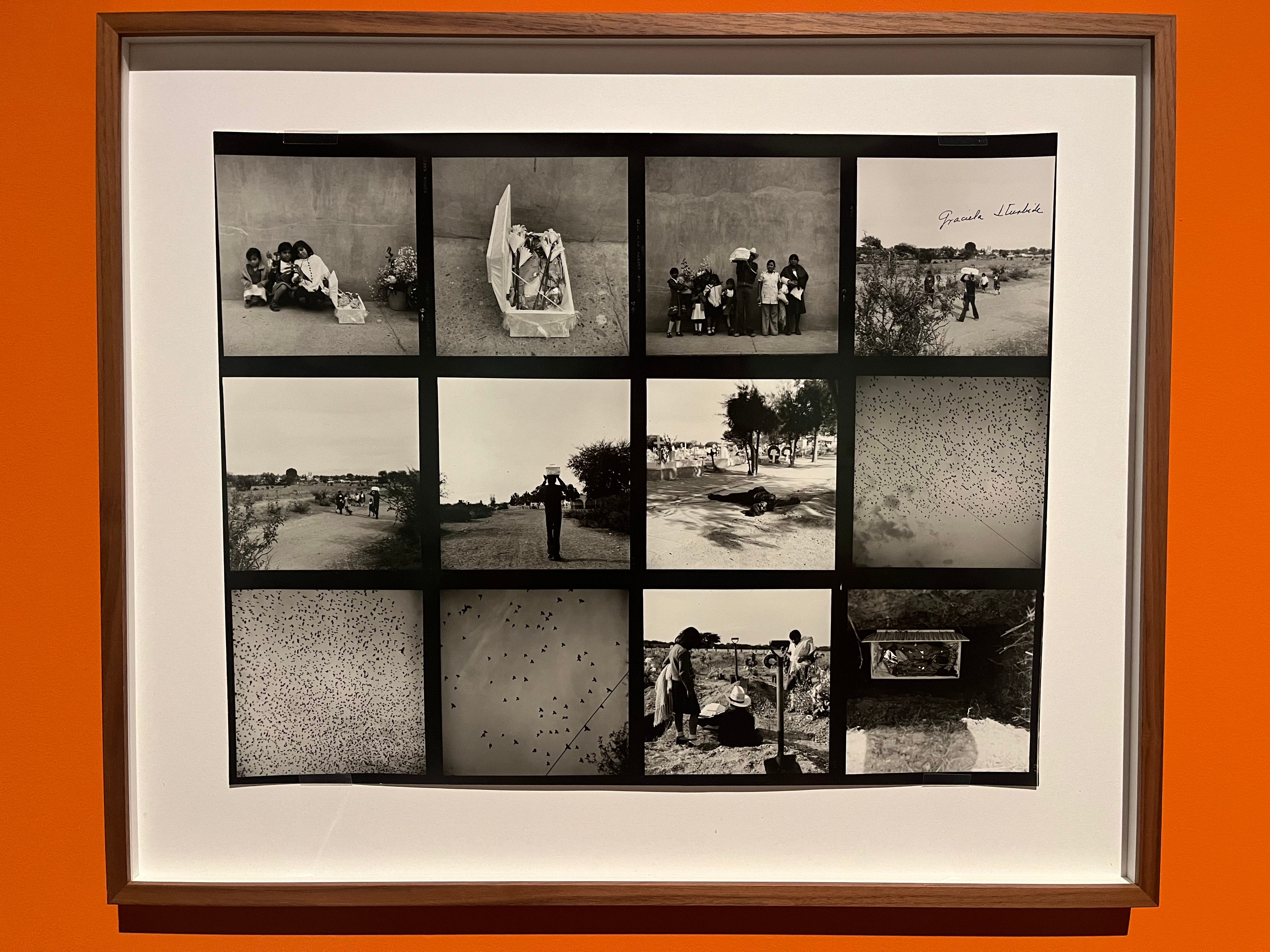
I take the baby to C/O Gallery to see the Graciela Iturbide exhibit. We’ve been in there only a minute or so before I hear her do an enormous poo. I wheel her out and put her in the lift downstairs to the bathrooms. But there’s no changing facility in the bathrooms. So I kneel on the floor among the lockers, and put a blanket on the floor, and I change her nappy there. I try to look authoritative and like I know what I’m doing in front of the young girls and older women putting their belongings in the lockers nearby. Once she is changed and we are back upstairs she grumbles a bit, and then falls asleep. At last, I can focus on what I’m looking at. I’ve loved Iturbide’s photography for a long time, but never seen it anywhere but online. Now, photographs I’ve loved, like Mujer Angel, are huge and eerie and beautiful in front of me. In the middle of the room, there’s a series of pictures collected under the theme of ‘Death.’ I read the wall text, which includes Iturbide’s own writings. Of these pictures she says:
“Mexicans see life and death as conjoined, and are accustomed to living alongside death. There are many, many traditions and festivals centered on the theme. On feast days, people go to the cemetery; they take food, sing songs, maybe even take along a piano. On the Day of the Dead we give each other sugar skulls with our names on them to eat. We may play with death, but we also are afraid of it. This is why we try to face it straight on.
When I lost my daughter Claudia in 1970, I became obsessed with photographing death, especially children dressed as angelitos [little angels] after they die, as is the custom in Mexico. I felt the need to involve myself in the deaths of others, perhaps in order to come to terms with my own pain. In 1978 in rural Mexico, I came across some people carrying an angelito to the cemetery. I asked permission to take photographs. They agreed-the whole family even posed-and they opened the coffin so I could photograph the angelito. They allowed me to follow them to the cemetery in Dolores Hidalgo. On the way, the father turned to me with a startled, terrified expression. In the middle of the road was a body-half man, half skeleton. It was still wearing trousers and shoes, but had been pecked all over by vultures.
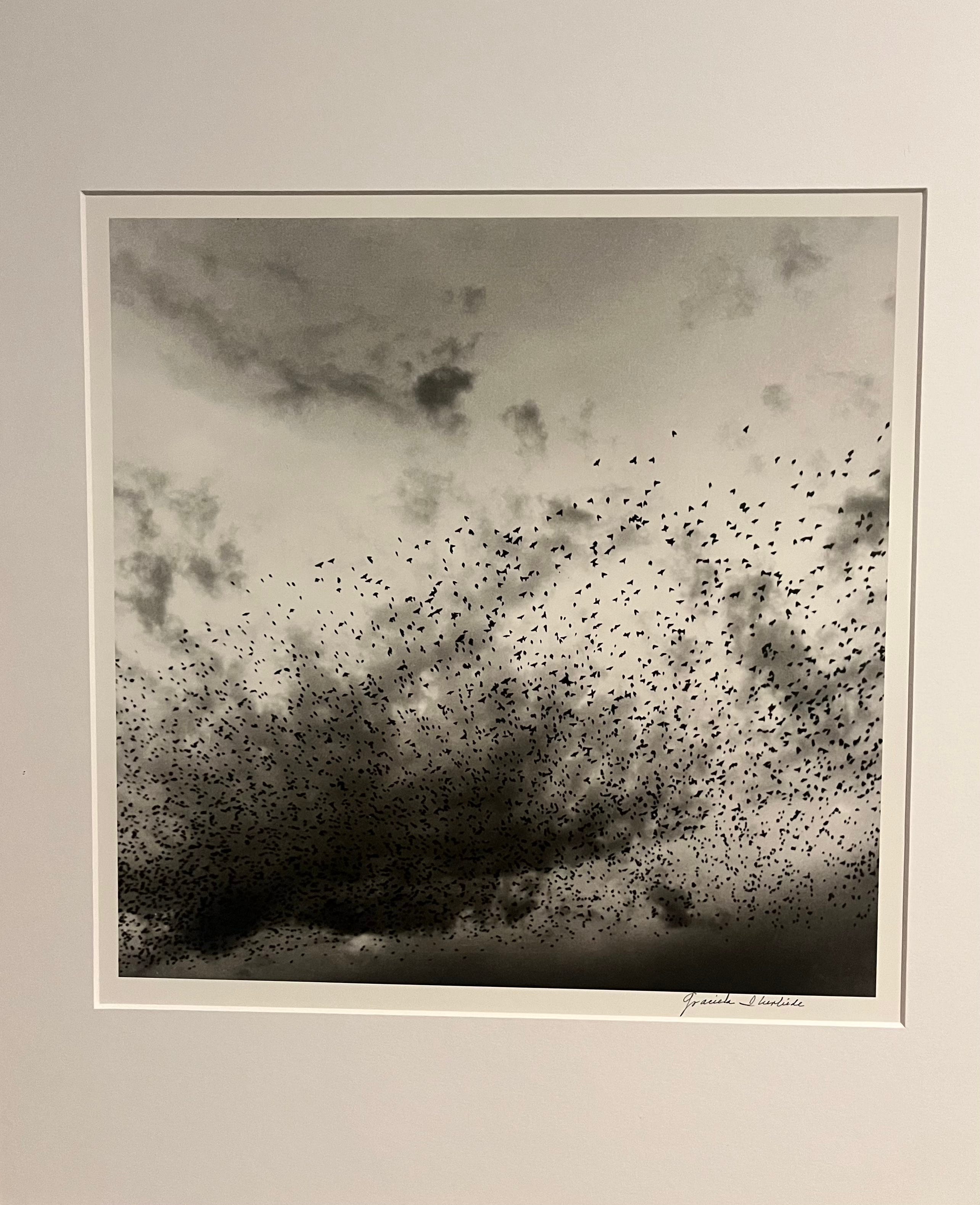
It was as if Death were saying to me, ‘You want to photograph me? Here I am.’ That is how I began photographing birds. Death appeared, and I thought, ‘That’s enough! Don’t keep living your suffering this way! In the cemetery, vultures were flying overhead, and I photographed the sky full of birds instead. All of this is to say that in life, everything is connected: your imagination helps you process reality.”
And then there’s the picture, in which all the pieces of the narrative are present like a comic book panel - the tiny coffin, the father on the road, the dead body, the vultures. Beside it, a single enlarged photograph of the Angelito. A white coffin with a baby inside wrapped in blankets, its perfect vacant face visible between stalks of white paper lilies. I feel a kind of jolting sickness when I look at it. I worry I might cry.
Every subsequent photograph of birds I see in the exhibit – there are many - gives me a feeling of foreboding, as though the murmurations were tantamount to dead children. It’s difficult to countenance. And I know these images wouldn’t have hit me in quite this way in my earlier life, before the baby.
Later, I buy a sandwich at the gallery cafe and breastfeed her at a table looking out at the traffic and people on Hardenbergstrasse. When she’s done, I ask for the bathroom key, and discover that they do, in fact, have a changing table in there. If only I’d known.
My hair is the knottiest I can remember it being since childhood. A bird’s nest, impossible to get a hand through. I’m certain it’s got something to do with how much of the hair is falling out. Getting stuck, tangled around itself. Lex was so grossed out by it the other day at Cafe Elf, all the strands of my hair collected in the baby’s grasping hands.
Her hands constantly in her mouth, her hands always sticky with dribble. My mother says a “toothy peg” is coming, and we are beginning to believe it. The way she will pull my hand into her mouth and gnaw on my knuckles until the bones begin to ache due to the sheer force of her gums.
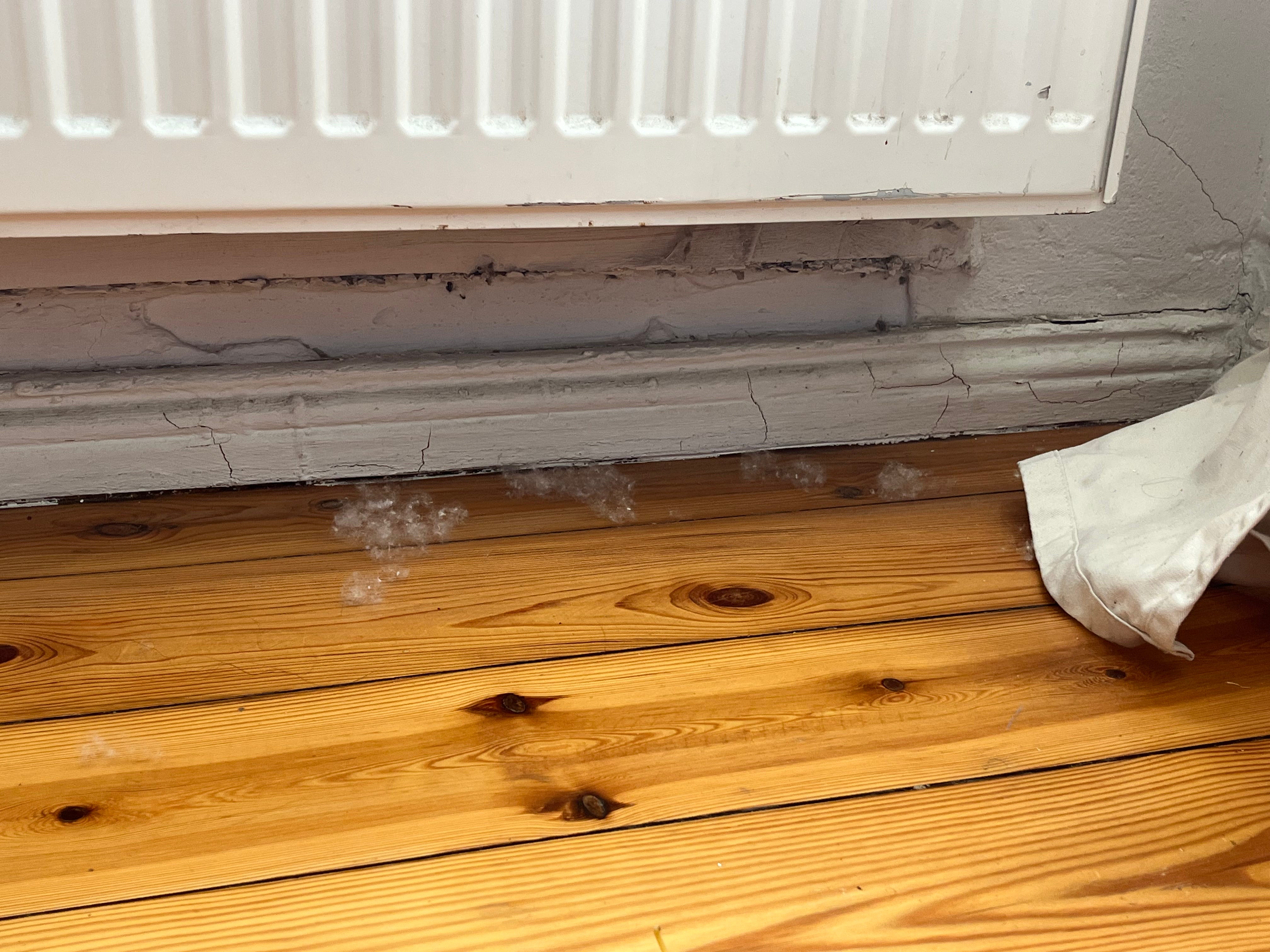
Flower fluff tumbles through the air, it’s all through our apartment, clouds gathered at the skirting boards. I ask Jessica and she tells me that it comes from poplar trees, and that it is, in fact, highly flammable. I walk through huge clouds of it as I cross Osloer Strasse to get to the Panke path. I take the baby up the river to the Volkspark and put the picnic blanket down by the water. She is quite peaceful, playing with her toy and holding my fingers as I try to read. Somebody is playing the public piano in the rose garden, versions of Beatles songs – ‘Penny Lane,’ ‘Eleanor Rigby.’ A woman passes by with a little boy of about three in a pram. When I look up again, she is walking down the grass verge towards me, saying in German that if I have my phone with me, she could take a photo. We look so lovely, she says, switching to English, and it’s such a special time, and she’s happy to take a photo of the two of us if I’d like. “Sometimes there’s nobody there to take a photo, you know?” And I smile as she takes a picture of me and the baby in the grass, and I suppose that we look like a kind of maternal idyll, the stuff of Instagram fantasy or commercials for life insurance.
I work in the writing room in the afternoon, even though the baby is a bit unsettled. I can hear her crying. Around three, V walks into the room without knocking, the baby in his arms, while I’m mid-sentence. I ask for more time — I am so close to finishing, and I say I’ll feed her when I’m done. Later he apologises and said he wouldn’t have come in if he’d known I was working. But I was so quiet, and it was so silent behind the door that he thought I’d fallen asleep on the rug. I tell him I wouldn’t use my precious, scarce writing time to sleep, but he says I’d be within my rights if I wanted to.
When we walk to the market through Arnimplatz in the morning, we find that suddenly there is yellow and white emergency tape wrapped around the trees along the path. Signs warn of poisonous oak processionary caterpillars and the various risks to human health that they pose – skin irritation and respiratory problems. V points, and it takes me a moment to see them, but there they are: hundreds of grey, hairy caterpillars, skulking and writhing around the trunk of the nearest tree.
I prepare for the Sebald event at Lettrétage like I’m taking an exam, with extensive notes that I revise all afternoon. I’m so nervous that I develop a stomach ache and can’t eat dinner. But once I’m on stage I’m cogent, the sentences come out clearly. During the break Martin finds me, just back from Australia. He tells me how much he likes these pieces I’ve been publishing, these collections of notes. I say I wasn’t sure about writing them anymore, but he insists (this one’s for you, Martin). I drink two glasses of wine and stay through the second half but I can barely form sentences by the time the readings are over. It’s only 10.30. When I get home, I realise I have to pump out all the wine-laced milk the baby didn’t drink, or else risk being woken by aching breasts, and so I sit on the couch half-dressed and exhausted, pumping and watching young people in the lit windows of the apartment across the street getting ready to go out for the night.
My cousin and her boyfriend come, in Berlin for the weekend from Utrecht. I tell her that I thought a lot about our grandmother when I was pregnant, tell her the story about what happened in the park at Blackheath, feeling the baby kick. She said that a while ago she went to that park, where our grandparents ashes are buried, and stood in the grass and talked to them. And that she’s not superstitious, but suddenly there was this gust of wind that came out of nowhere, and it felt like it was them. I am stunned. I tell her that the exact same thing happened to me as well; I stood there heavily pregnant in the grass off the path, talking to the place in the bushes where we buried them, and then — on an otherwise still afternoon — a gust of wind came up and rustled the trees and bushes around me, a gust of wind that felt like communication.
I have mosquito bites everywhere, more than I’ve had since childhood, all over my legs and arms, my stomach, even my face. V has none, and so far the baby seems to have none. I theorise that maybe there’s something about breastfeeding which is making me more delicious to mosquitoes. I wake up in the morning before the baby and can’t get back to sleep because of all the itching.
A walk with Nitzan and her daughter in Hasenheide. Both girls getting hot, and both eventually falling asleep. We talk about our grandmothers, and how both of our daughters are named after them, in one way or another. I tell her about the kicking and the wind in the park at Blackheath. How my grandmother and my daughter were born one hundred years apart. She talks about her grandmother, born in Berlin, and sent away on the Kindertransport, never to see her family, nor Berlin, ever again. Giving birth to her daughter in Berlin, giving her her grandmother’s name, was a way to complete the circle.
I take the baby in the morning and walk her up to Gesundbrunnen in the carrier, but when I get home, while I’m feeding her, I find I can’t breathe. I have to stop mid-feed, leave her there bellowing on the bed, and go to the kitchen for water. When the water doesn’t work and I still can’t get air in, I have to take some of V’s ventolin. Allergies which seem to have emerged only postpartum? Or caterpillar hairs in the lungs?
At 12.35am we wake to her crying, and I am up immediately and turning the light on. But her eyes are closed. Her mouth an exaggerated down-turned U, she’s thrashing around and crying out, but her eyes stay shut. I sit beside her. After a while her eyes open, fix on me, and then drift closed again. She falls into regular slow breathing. The internet suggests that children only start dreaming around two. But that’s only because they have enough language by then to tell you they’re dreaming. We are certain that she dreams. Certain that she’s just had a bad one.
I ordered three pairs of trousers and two tops from Sézane. They arrive in the afternoon. The baby is lying on the bed and I am acutely aware of her watching me as I try on each pair of trousers in turn which don’t fit properly. Not one of them. The tops, too, don’t fit. She is looking at me and I am trying to keep my face neutral but I know she can probably tell that whatever I’m feeling is a kind of immense despair. My body is alien to me now, I don’t know its new shape. But more than that, I hate that she might experience me the way I experienced my mother’s hatred of her body. I pick her up, cuddle her, take us both away from the open box with its wrong-shaped clothes and into another room.