
Third Month
Notes from the 90th day of motherhood.

This collection of notes is part of a series I am writing month-by-month, recording the early stages of motherhood. Click here to read ‘First Month’ and ‘Second Month.’
My second novel, Elegy, Southwest, is out in paperback now. You can buy it here (US), here (UK), and here (AU).
I was advised by a physiotherapist at the hospital to do a Rückbildungskurs at 8 weeks postpartum, to help recover my pelvic floor. The only English-language one I can find is in Kreuzberg, so I get the U-bahn south each Wednesday morning. During the second session I watch a circle of wetness bloom on the singlet of an American woman. I watch the circle over her nipple grow bigger and then dry. I have no idea if she knows it’s happening. At the end of class, we are instructed to lie with our legs in the air, moving them up and down by a matter of inches. Everything in my lower abdomen feels weak, entire muscles displaced. A collective groan rises up from the floor, a room full of agonised women.
We walk together with Rob and Mathilde along the Landwehr Canal, and as we walk we realise we’re recreating the walk we made in the summer, when both Mathilde and I were newly pregnant. Now, both men wheel prams. As we walk by Vivantes, Rob talks about the incredible mystery of where these beings – our children - emerged from. He says it feels like his son was just beamed down from the sky, right there, pointing at the hospital, as though we might all see a cone of white vertical light penetrating the beige concrete tower.
My mother-in-law arrives from France for two weeks. I ask her to take the baby for an hour in the afternoon so I can write, but all I do is write these notes. I can hear the baby squall in the other room and feel like I should go to her. I can’t concentrate for her crying. I sit at the desk paralysed by feeling how small an hour is, and how little I’m doing with the time. This push-pull of wanting to write and wanting to care for the baby.
I notice I keep using the verb ‘squall’ to depict the baby’s crying and complaining. A word borrowed from the weather reports of childhood; Mike Bailey describing a coming storm on the 7pm ABC news bulletin. Dark clouds, sudden wind gusts, a curtain of heavy rain – that is the sound my baby makes.
At the Rückbildungskurs a Canadian woman asks what to do when she sneezes or coughs. “So I don’t feel like I’m falling out,” she explains. She looks athletic, with muscled calves and broad shoulders. I surprise myself by how much I find I’ve assumed about her from the way she looks in gym clothes; that she would have it easy. I feel fine when I cough or sneeze, and I am grateful to know that it might be otherwise.
For the last few nights, the baby has slept from 10pm until 5 or 6am, without waking. Because she’s sleeping for so long in the night, she wants to be fed incredibly frequently during the day, every hour and half. I am exhausted. Emptied out and limp and useless. I am also hungrier than I ever was during pregnancy. This morning, I was so hungry after I fed the baby that I was almost nauseous. It was 6am, the lights were off and the baby back in her crib, but I had to go into the kitchen and cut up an apple, bringing the four pieces back to bed in a small bowl and crunching through them in the dark before I could sleep again.
I feed the baby and then rush out the door to meet Lauren at Gropius Bau. How strange to put on perfume again. Lipstick. The rituals of ‘going out,’ as though through sense-memory I am being returned to my former self. I have only a small window of time to see the Peter Hujar exhibit. The photographs of the Hudson River! The empty and deserted streets of Manhattan! The piers! I have seen many of them before, and they still move me immensely. They make me homesick for New York. We talk a little about Lauren’s love life, but there is barely any time before Andrew Durbin begins his reading. The strange sensory overload of being in an audience: the smell of Lauren’s perfume on one side and a nearby woman’s cigarette smoke. A reminder that I am unused lately to being around so many people. Questions finish two minutes before the time I need to leave. No time to talk to anybody, barely time to say goodbye to Lauren. I rush back out into the night, to make sure I am home by 9pm to feed the baby.


I wake up in the middle of the night, my breasts rock-hard and aching. I have leaked through my sleep-nursing bra, even though I’m wearing absorbent pads. The baby is sound asleep. I consider waking her but can’t bear to, so I quietly fetch the breast pump, go into the kitchen to collect the sterilised parts, then sit on the couch and pump milk for 20 minutes, in mouth guard and eye mask pushed up into my hair, looking out at the dark windows of the apartments across the street, and the infrequently lit ones, where people don’t seem to be awake so much as having forgotten to turn their lights off before bed.
We’re buying Saturday groceries at the supermarket by Arnimplatz. I’m turning from the display of cheeses into an aisle of canned vegetables when I hear a woman speaking English in an American accent. It clicks only as I’ve turned and begun to walk away that I know whose voice it is. It was a friend, one of a handful of women who disappeared from my life last year after I told them I was pregnant. We haven’t spoken since last summer. I still have time to turn back, to say hello to her, but I keep walking down the aisle, away. It takes five minutes or so for me to wonder why my instinct was to avoid her. I am hurt by her disappearance, but I do not think it was deliberate, nor malicious. I tell myself I will say hello if I see her again, in another aisle of the supermarket. But I don’t see her again. And, afterwards, I don’t text her either.
My father arrives from Melbourne. At the hospital they impressed upon us the measures that cigarette smokers must take around a baby – hand washing, a change of clothes, never smoke when the baby is nearby. I have worried about asking these things of him, but he accepts them with grace. The problem is that he’s been traveling for two weeks, and everything he owns has been penetrated by cigarette smoke. I smell it on him, familiar, redolent of my childhood. It used to smell like comfort. In the early evening the baby falls asleep for an hour on my father’s chest; he is besotted with her. I’m sitting on our bed, pumping milk. V comes into the bedroom, the baby in his arms. He tells me that she smells like cigarettes. I bury my face in the baby’s shoulder, and I can smell it too. She smells like cigarettes. “I’ll talk to him,” I say. “We’ll do a wool wash.” I hold her very tightly.
On the U8 in the morning with the baby in her pram. A junkie with red, scabbed hands is nodding off beside us in the accessible area of the carriage, sitting in the fold-down chair. Another man who gets on at Gesundbrunnen stands a foot away, muttering to himself. At Alexanderplatz a young man boards with a bike, blocking the exit. Instead of moving his bike to the side when I need to get off at Kottbusser Tor, he instead lifts the front wheel and swivels it so that it hangs ominously over the sleeping baby in the pram. I swear at him, and realising his sudden stupidity he says a shameful “sorry” as I wheel her out. Waiting for the lift, I wonder whether this thrumming thing I’m feeling, this heightened sense of danger, is what turns so many people conservative after they have children.
In the evening, I am looking at old photos with my dad, trying to find a specific photograph of myself as a toddler, and as I flick through, I pass a photograph of myself at four years old, posing in my mother’s back yard, on the day we first marked Red Nose Day. The red plastic nose hangs on an elastic around my neck, and I’m wearing a winter dress and a hat with a big sunflower on the brim.
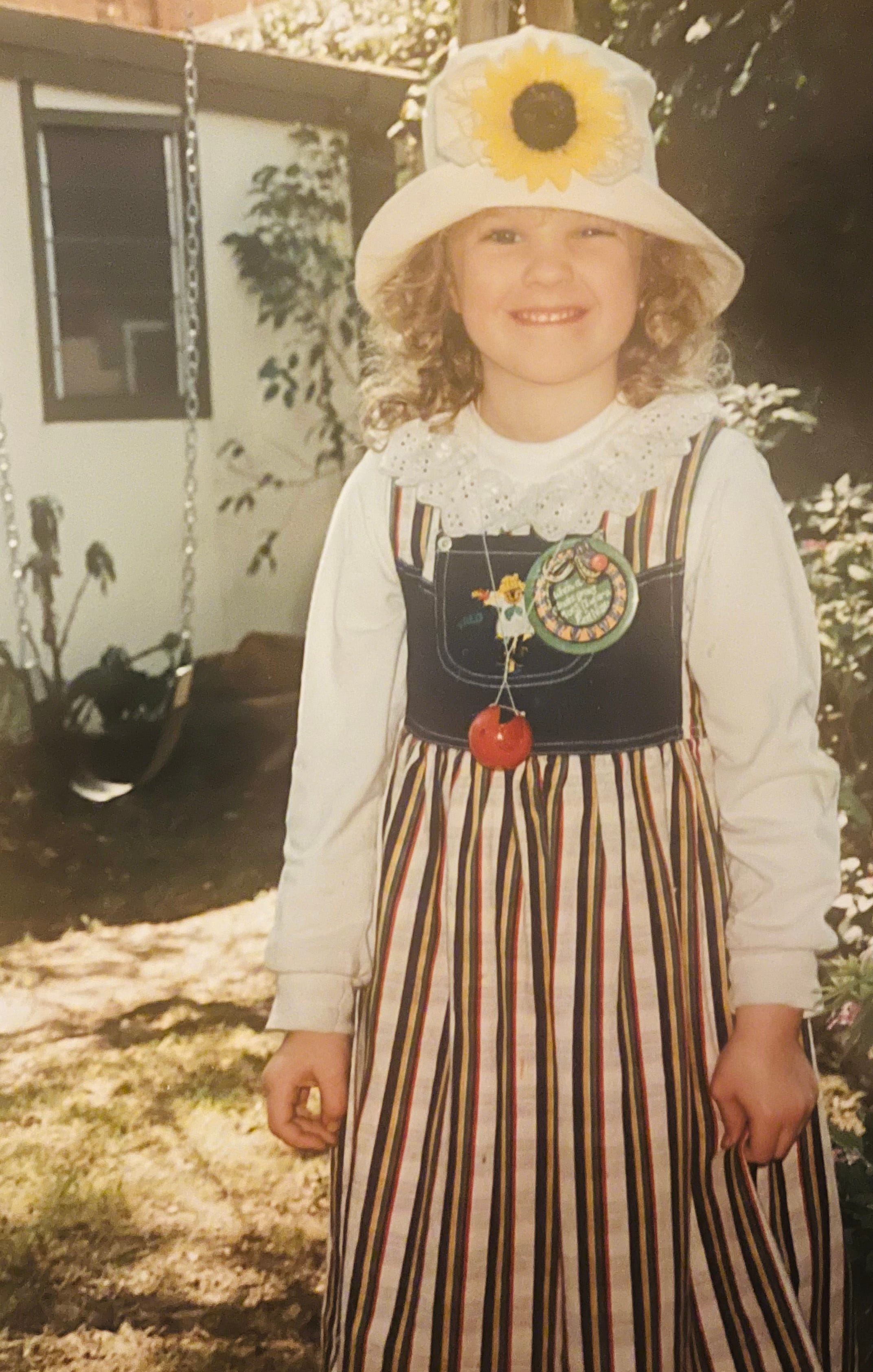
I’m surprised. I ask my dad how old T was when he died; I had thought he’d been alive six months, but he can’t have been if I was wearing a winter dress. “Three months,” says my dad. He holds out his hand and folds down the fingers: “May, June, July, August —yeah, three months.”
My stomach lurches. My own baby is not yet three months old. But she is already so much a person– her careful, merry thrashing in the bath, her gummy smiles, her burbling attempts at communication, the look of wonder she bestows on every light fitting. All of it specifically her. I could not appreciate before now how much personhood is lost when you lose a three-month-old baby, and the tragedy of my half-brother’s death – from SIDS, in August of 1994 – strikes me anew.
Strands of my hair clutched always in her little fists. I pull them through her clenched fingers very slowly, so that she doesn’t even notice I’m taking them back.
In the afternoon V is playing the baby ‘Everybody Needs Somebody to Love’ by Solomon Burke. She is lying on her blue play mat, a huge gummy smile on her face, and keeping furious time with her left leg, pumping it up and down to the beat of the song.
Reading Kate Briggs’s novel The Long Form. In one scene her protagonist is describing being called ‘Mum’ by a maternal nurse when she was pregnant. She realises she is meant to recognise herself in the word and respond to it as though it were her name.
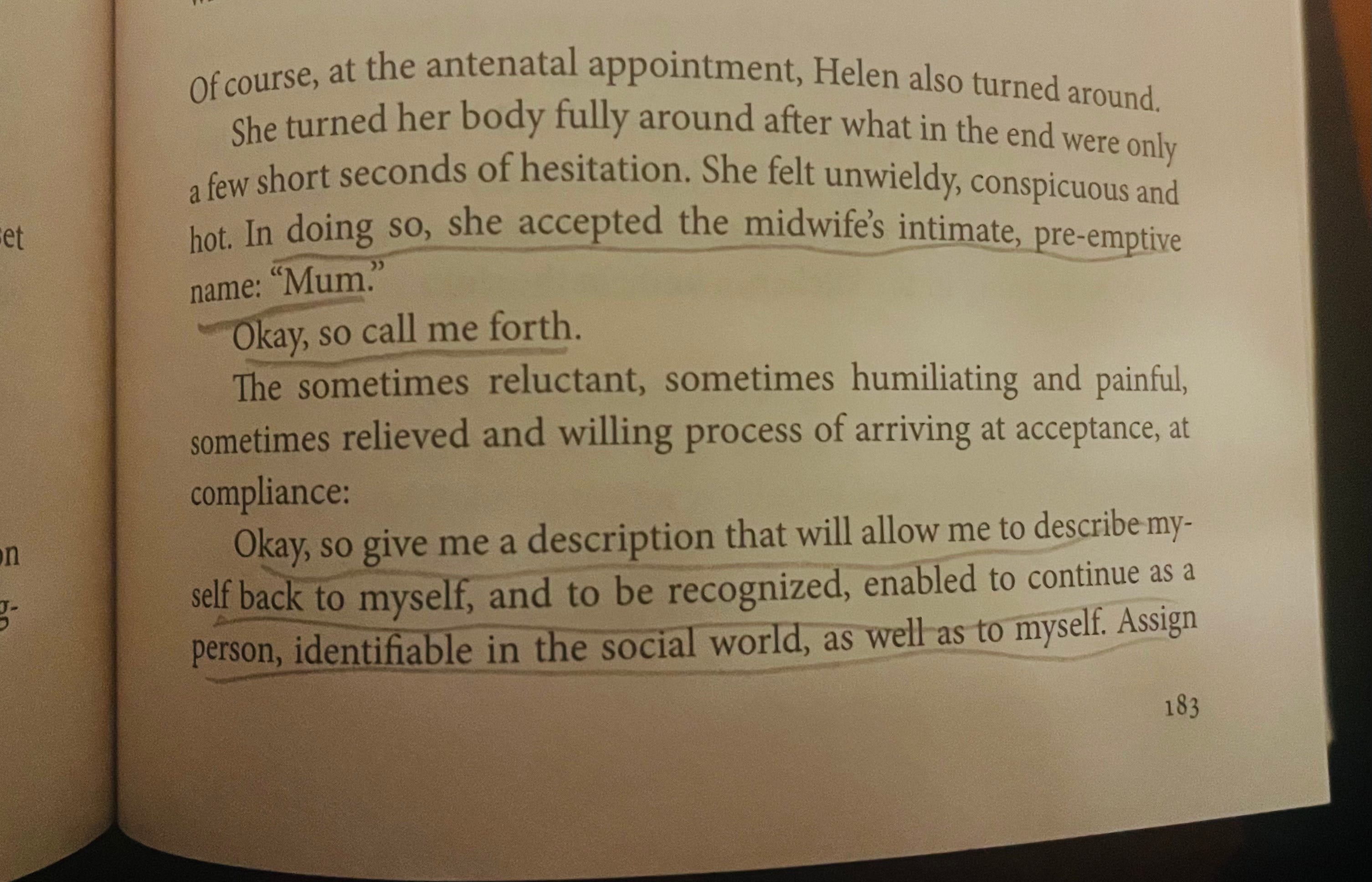
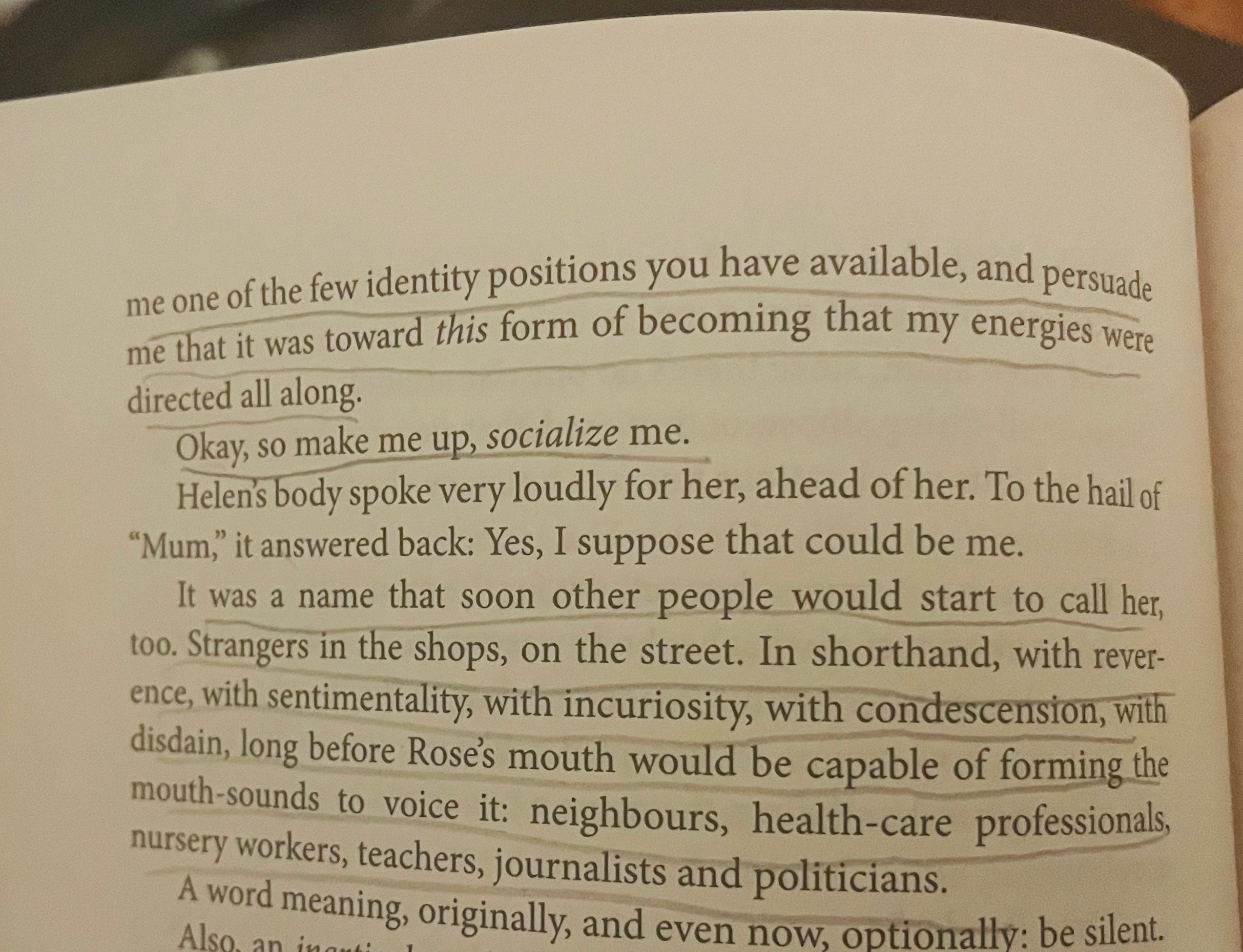
I recognise myself in this passage, and the feeling of estrangement when I am addressed now by another adult as ‘Mum’ or ‘Mutti’ or, even worse, the American ‘Mom.’ The sheer baggage attached to the word – it’s like being handed someone’s second-hand coat weighed down with the former owner’s possessions. I have no problem saying, “my daughter,” but being a ‘Mum’ in the social and historical sense, a ‘Mum’ outside of the personal relationship I have with my baby, still doesn’t feel like a name I can answer to.
I am in the kitchen cooking dinner while the baby is in the living room with V, watching Chelsea play Port Vale. I start chopping, listening to a podcast. It ends and a new one begins; an Australian true crime podcast I follow but rarely listen to. This one is on Kathleen Folbigg, and because my hands are covered in potato starch, I don’t turn it off. I listen to the first eleven minutes, which details the death of Folbigg’s son at 19 days - discovering him in his cot, his lips blue. I wipe my hands on my skirt and turn it off. I can’t handle it.
And at that moment the doorbell rings and my father arrives, fresh from his afternoon trip to the Holocaust memorial and the Bundestag. He comes in as I’m turning the sausages and offers to help, taking a board to the other end of the kitchen bench and beginning to chop. I tell him about the podcast on Kathleen Folbigg, and then after a small silence, I ask if we can talk about T. He says, “of course.” And so we do. We talk about his death for the first time since I was a child.
After speaking for a long while, my father says, sort of joking and looking at the fridge, “I probably need a drink,” and then, turning back to me, “do you have any more questions.”
“I do,” I say. Just one: did he have any blankets on him when he died?
No. There were no blankets. There was no explanation for his death, none at all.
Afterwards, it occurs to me that what I had hoped he would say was, “yes, there were blankets over his face.” Some kind of explanation for his death, something to alleviate the horror.
Easter Sunday, and figuring there’d be no one there, V and my dad rent a van and I walk to meet them at the writing studio to clear out my things. Someone has left a Lindt chocolate bunny on my desk. Someone had also filled the leg space beneath the desk with cardboard boxes. There’s still a dried-out teabag in a mug in the corner, lipstick-stained rim. I’d had no idea I wasn’t coming back.

As my father and I walk back towards my apartment from the U-bahn, he talks about how much he will miss us all. And he says, as he has said so many times since he learned I was pregnant, that he never thought this would happen.
“Do you mean you never thought you’d be a grandfather? Or that I wouldn’t have children?”
He clarifies that he thought I wouldn’t have children, and mentions the conversation we had last April when I was staying with him in Melbourne. He thought, from what I had said back then, that having children would be impossible for us.
On Wednesday I tell V about this conversation as we are heading into the Bürgeramt where we are applying for the baby’s German passport. I tell V about how strange I find my father’s lack of insight back then; my father interpreted that conversation on his couch last year as determinate proof that we wouldn’t have children, rather than what it was—a deep and full-throated monologuing of worry, which I often conduct even if the worry isn’t especially well-founded. About a week after that conversation - in early April - I got my period, and that was the very last period I had - my whole pregnancy was back-dated and in constant reference to April 17th, 2025.
On a FaceTime call with my sister the baby smiles and sneezes at her, but after fifteen minutes she does an explosive shit I can feel against my arm, and I say I have to go. We are saying our goodbyes when I turn to the baby, and I say “bye-bye Auntie Cesca” as though instructing her, or speaking for her. I catch myself, turn back to my sister, and say “sorry, she’s twelve weeks old, I know she can’t say goodbye.” I’d always thought it was ridiculous – parents speaking for their children who have yet to acquire speech - but now I find I do it all the time.
Maybe because space has been in the news – the Artemis II mission - I find myself describing these first months to people as like being in a spaceship traveling out into the far reaches of the galaxy. It’s interesting, and incredibly beautiful, full of wonder, but I feel very far away from my life back on earth, from other people, from global events, and from the details of ordinary life.
I go to the café at Silent Green to meet a librettist who emailed me at the recommendation of a Sydney publisher. I’m willing the baby to sleep quietly in the bassinet beside me - she’s done it before. We drink our hot drinks, and the librettist asks whether I’m writing about motherhood - having read my books, he thinks it makes sense that I would write about pregnancy and motherhood now it’s come for me. I tell him that I’m trying, although I’m not sure what will become of this kind of writing, if anybody will want it. But the baby keeps complaining, little cries, like a magpie. Eventually I lift her out of the pram and hold her on my knee. But her squawks grow into screams, and she thrashes about. She’s not hungry because I just fed her, and her nappy is fine. She just doesn’t want to be in the pram, and she doesn’t want me to talk to this stranger. I ask if we can walk through the cemetery next door, hoping the movement will calm her down. I want to keep having an adult conversation, want to be present as a writer, and not a mother trying to shush a baby. We walk, but after a spell of smiling at the librettist she reverts to screaming, and in the middle of the path I tell him I will have to go, and I whisk her away, screaming down the street. After two minutes of brisk walking over cobblestones her eyes drift shut and she finally falls asleep. I feel rattled, and vaguely ashamed of myself.
Hunter comes over for dinner in the evening, looking fresh-faced and resurrected - a man newly in love. Over dinner I tell him that time itself has taken on a new meaning in these last weeks. I tell him about the Kate Briggs novel, and a section wherein Briggs is describing a series of lectures E.M. Forster gave in 1927 collected in a book titled Aspects of the Novel, and one in particular about time in narrative fiction. He argues that we abide by sequential time, but we also experience moments of intensity which prolong or speed up the clock-time of our memories. Briggs describes the lecture hall where Forster is delivering his thoughts, and imagines a version of her protagonist storming through the audience to the lectern, presenting the baby wrapped to her chest, and saying,
“Consider not a general idea of a baby but an actual baby with a weight, and presence, whose needs pitch and fall but don’t stop. Think about how, if there is such a thing as denial - a categorical refusal to recognise and submit to socially organised, collective, “official” time - then here it is. Here is that denial in a sling, and requiring someone’s care.”
She imagines Forster trying to calmly reason with her, but her protagonist interrupts him. “Rose [her baby] SMASHES time! She fucking smashes it.” And she goes on:
The point is, I know time. I know time differently now. I know it because I am unlearning it. It’s not a knowledge particular to me. I know it because the baby is teaching me that the rhythms of the clock and the calendar, and even the most elemental diurnal patterns - they don’t go without saying: they are acquired, if not violently imposed. It is a lived and not an abstract form of knowledge that comes from living alongside a beginner - the way the days can all of a sudden feel like they’re undivided, divided by nothing, only water…
I am telling Hunter all of this when I realise: it’s already changed. In those first weeks, the baby had no calendar, no clock, no sense of night or day, the moon or the sun. She was a creature of my body. But after three weeks of sleeping through the night, one can no longer say she has no relationship to sequential time. She’s learned it, learned nighttime, learned sun and moon. And in so doing she has grown further away from me, from the time when our bodies were indivisible. She has grown, in these last three weeks, more a part of the world.

Up at midnight pumping milk, I remember something Madison said in our group chat about breast pumps: “it sounds like you’re pulling out the world’s saddest vibrator.”
I take a child and infant first aid course on Saturday morning. V took it last month, and said it was wonderful, but this month it’s being taught by a new instructor, a 40-something Russian woman with long white-blonde hair extensions and knock-off ugg boots. Her English is patchy, we all have to translate for her. She tells us, for instance, to “fixate the baby’s head” if it is choking. She is full of anecdotes about her own life and of Russia, about how her daughter broke her hand when she fell off a scooter and her husband blamed her, which was terrible because it wasn’t her fault, and how her friend does jujitsu to relax, which she doesn’t judge her friend for doing, not at all, and how her son back in Russia once plugged a broken adapter into the wall and it exploded and her son went flying across the room but her mother-in-law - Gott sei Dank - saved the day. She tells us many things are banned or not recommended by the EU, but they do it in Russia and we should too (using a tourniquet, putting a slice of potato on a burn).
After an hour of anecdote she gives us a break. As I’m standing in the hallway outside the bathrooms texting V about how bad the course is, she passes me, stops, holds her hands an inch from my breasts, and makes a cupping motion, saying “Oh, I wish I was like that.” She takes a few steps, turns, and then asks, “You are stillen your baby?” When I nod, she grins and pats her nose with her finger.
After the break she covers CPR, which involves many jokes and a rendition of the Bee Gee’s ‘Staying Alive’. As I watch her demonstrate, I grow suddenly very quiet and feel like I have left the room. I am remembering my father telling me a week ago about giving T CPR after finding him unresponsive. I imagine it as I bend over the dummy baby to perform the five rescue breaths and the 30 chest compressions necessary when providing CPR to an infant. Did my father cover the mouth and nose of my brother when he delivered oxygen from his own mouth?
At 1pm she tells us we’re done – the class is meant to end at 3.30pm. A Portuguese woman with whom I’ve been sharing raised eyebrows asks whether the Russian woman has any tips on risk prevention. She raises her fingers to her eyes and then points them outwards. “You are having eyes on them 24/7. You are a mother 24/7. You never stop watching.” A German man in a Patagonia vest asks if he can go to the toilet while he’s watching his baby. “Maybe,” she says, shrugging, “but things happen.”
In the afternoon, after the first aid course, we are at Prater celebrating Blake’s birthday. The baby begins to grumble, and I tell V I will feed her. I turn, with the baby held tight to my chest, but I haven’t realised we are standing next to a low step, maybe an inch or two high. My boot rams into the concrete and I tip over, head-first. I take a staggered step into the gravel, and then another, righting myself with all my might. Panic and terror. The baby screaming like I’ve never heard her before, frightened. She hit her chin on my clavicle as I went down, and sensed my terror in the way I was gripping her. I recover, and V walks with me to some empty benches on the edge of the beer garden, saying I had done a good job in figuring out how not to fall. But I am shaking as I feed her, taking deep, focused breaths like I did when I was in labour. I turn to him and say, “I could have killed her.” It was sheer luck and chance that I averted the fall, didn’t crush her. Unbelievable luck. She does an explosive shit then, and it distracts us, but later in the evening I find myself on the verge of tears, looking at her and imagining her breathless or bleeding or turning blue. Putting my hand out to touch her rising chest. Confirming her continued all right-ness.
i love these so much
This was so moving - and transported me back to those months of my own. I’m glad you are finding time for the writing 💕