
My Year In Lists

As is traditional, I wanted to send out an end-of-year round up of everything that I loved reading and watching and listening to in 2025.
I will also take a moment to collect everything I personally published this year as well. 2025 was a really enormous year for me, professionally and personally (and also profoundly difficult in all sorts of ways I hadn’t anticipated!) I published more this year than I have in the last couple, and I am very proud of the following:
Elegy, Southwest - my second novel, which came out in February and March, and which took more out of me than anything I have ever previously written. I also happen to think it is the best thing I have ever published.
Tentacle Memory - a short story I wrote for Broadcast by Pioneer Works for ‘Heat Week’, about early pregnancy and jellyfish and heatwaves, originating in the experience of being stung by a Mauve Stinger jellyfish when I was 7 weeks pregnant in France.
Baby Pictures - an essay commissioned by Westerly magazine in Australia, about baby photographs and ultrasound pictures and lines of maternal connection. Includes said baby pictures!
When The Water Falls - a piece for Orion about Robert Smithson’s great work of land art, ‘Spiral Jetty,’ built in the 1970s on the shores of Utah’s Great Salt Lake, and the way that it has inadvertently become a perfect proxy for the story of climate change in the American Southwest.
Antigone Kefala and the Art of Exile - an introduction I wrote to Kefala’s gorgeous, slim novel The Island, published in the US for the first time this year by the wonderful folks at Transit Books, and reprinted in The Nation.
W.G. Sebald’s Rings of Saturn Might Be the Perfect Climate Change Novel - an essay for Lithub (hence the title) on what I consider to be one of the truly perfect books, and the deep impact it had on me as I wrote my second novel.
Read
The City Changes Its Face - Eimear McBride (2025)
I am generally of the opinion that Eimear McBride is one of the greatest living writers working in English - what she does with language, with gesture, with emotion, with sex! - and was naturally inclined to love this, a sequel to 2016’s The Lesser Bohemians. If you’ve not, you should read The Lesser Bohemians first - it’s the beginning of the love story - not only because it’s brilliant, but a lot is lost in the sequel - in which early love has become richer and deeper by domesticity and the sheer complications of life - if you’re coming in cold.
Theory and Praxis - Michelle de Kretser (2024)
I stubbornly resisted reading anything by Michelle de Kretser until this year, when I read several of her novels in succession and was utterly floored by her writing. This, her newest, was my favourite, read in a one, big jet-lagged gulp in my father’s spare room after landing in Melbourne in April - a campus novel without compare, a story of intellectual becoming, but also filled with a delightful gossipy frisson concerning the University of Melbourne in the late ‘80s.
The Sorrows of War - Bao Ninh (1991), 2024 translation by Frank Palmos and Phan Thanh Hao
A gorgeous, devastating book about the aftermath of the war in Vietnam from the perspective of a North Vietnamese soldier, told in stream of consciousness during a trip when the protagonist has been sent out to collect the bones of his fellow soldiers for reburial. Nothing is linear in this book, rather, memory is the driving force behind the flow of the prose, jumping around in time without ever losing you. And to my shame I think this is the first account of that war I’ve encountered from the perspective of the North Vietnamese, and in that sense felt like a little revelation.
Red Comet: The Short Life and Blazing Art of Sylvia Plath - Heather Clark (2020)
Approximately 1000 pages long, and I was riveted the whole time. I was extremely enamoured of Sylvia Plath as a teenager, and then drew away from her during university when I got the sense it was viewed as a little distasteful (in the English department, at least) to still adore Plath into adulthood. The beauty of this book is it returned me to Plath - who was in fact richer and more sophisticated than I could appreciate as a teenager - and takes her work incredibly seriously. After completing a book or a big writing project I have a tendency to turn to big biographies of creative women - looking for models on how to live, I guess? - and this book was the one with which I most intensely connected (although honourable mentions go to Francesca Wade’s biography of Gertrude Stein, Carrie Rickey’s on Agnes Varda, and Howard Fishman’s of Connie Converse).
Bobbin Up - Dorothy Hewett (1959)
I think this is out of print everywhere in the Anglophone world, which is a shame because this is such a beautiful novel! Set in 1950s working class inner Sydney, each chapter is told from the perspective of a different woman working at a spinning mill in Alexandria as they face imminent layoffs, and which culminates in a sit-in strike at the end of the novel. It was so exciting to read a work of Australian proto-feminism which was this class conscious and political at a time when Auslit was - although often aesthetically gorgeous! - just a bit more milquetoast generally. Hewett also writes these ecstatically beautiful descriptions of Sydney which made me incredibly homesick! Rhapsodies on King Street traffic and the filth of the Cooks River!
Privacy - Molly Young (2025)
A dear friend arrived in Berlin from New York this summer and handed this to me with some urgency in the middle of Karl Marx Straße, quite insistent that this book was necessary for me. It’s really rare to encounter books which focus exclusively on pregnancy - motherhood books abound, but pregnancy itself is always squished in as a kind of preamble, or afterthought, never given the attention and space Molly Young gives it in this very slim zine.
The Quickening: Antarctica, Motherhood, and Cultivating Hope in a Warming World - Elizabeth Rush (2023)
I hadn’t expected to be so gripped by a book which is, for the most part, about observing a scientific trip to Antarctica, and yet! There are questions being asked in this book, and a kind of elasticity around the timeline, which means that the question of the future, and in particular the very specific connection you feel to the future when you are growing another person inside you, is always in absolute focus. I didn’t find it ‘hopeful’ as such (I feel allergic to this word after having written two climate change-adjacent novels), but I did find it profoundly consoling.
Childish Literature - Alejandro Zambra (2023), 2024 translation by Megan McDowell
Utterly delightful! All aspects of childhood are at work here - the narrator’s child, the narrator’s own childhood, the childhoods of others which are brought into focus by having one’s own child, etc. It’s also a remarkable fuck-you to the masters of form - are these pieces short stories, essays, vignettes? Who is speaking? Does it matter?
The Wax Child - Olga Ravn (2023), 2025 translation by Martin Aitken
I find Olga Ravn’s novels really exciting, and this in particular felt like an incredible way into writing ‘the historical novel’ - in this case, a story about real women killed for practicing witchcraft in Denmark, narrated by the buried ‘wax child’ one of the women had fashioned and used to practice magic with.
Youth - J.M. Coetzee (2002)
This is the second in Coetzee’s ‘autobiographical trilogy’ which I have been reading out of order (they are remarkably difficult to find! I had been looking for this for years when I found it in Edinburgh during my two-day Book Festival visit in August). My favourites are still Elizabeth Costello and Summertime (the third of the trilogy), but what I loved about this is the sort of glee with which Coetzee makes his autofictiony persona so profoundly unlikable. There’s an incredible grouchiness with which he approaches the very idea of ‘confession’ inherent in an autobiographical trilogy of novels, such that you emerge from these books feeling toyed with in the best way (I also feel very energised after reading Coetzee, I had an idea for a novella while reading Youth which I took furious notes on for a few days - maybe one day it will get written).
Poor Ghost! - Gabriel Flynn (2025)
It’s really lovely when one’s friends produce work you genuinely love, without qualification. I got to see this novel being written, and it was such an utter delight to read the final product. One of the big surprises is that I had, all those years ago, thought of this book as a Manchester novel, a book dedicated to capturing a specific place, and on reading the final version this year I was delighted to discover that it is that, yes, but it is really a book about fathers and loss - it comes upon you all of a sudden and just wrecks you.
Big Kiss, Bye-Bye - Claire-Louise Bennett (2025)
I love how idiosyncratic Claire-Louise Bennett is, and the way her voice is so consistent across all her books, so particular and in many ways so resistant to the reader, to making things comfortable or cohesive, even as her voice is always so polite and sometimes quite mannered. When this came out there was a Guardian review of the book I found particularly irksome, which to my mind essentially conflated Bennett and her narrator, and led with the assumption that there was something wrong with the novel because the critic couldn’t understand why the narrator made particular choices about men and sex, choices the critic personally would not have made (I find this to be a common criticism women make of other women’s art, and it reminds me unpleasantly of being back in high school any time I encounter it trussed up as an intellectual argument). The fact that Bennett does not in fact pander to this kind of ‘please explain your behaviour’ genre of (poorly thought-through and invariably misogynist) criticism is what makes her writing so remarkable.
Sad Tiger - Neige Sinno (2023), 2025 translation by Natasha Lehrer
An incredibly intense book, the subject being, in this case, about the author being systematically raped by her stepfather as a child and adolescent. But it’s unique in that it’s also very much about the ways in which narrative and storytelling itself can and should resist our expectations of a ‘trauma narrative’. I read this in close proximity to another book I really loved this year, Manon Garcia’s Living With Men, on the Gisele Pelicot trial, and they make an particularly interesting pairing not just because they both touch on sexual violence in France and the French judicial system, but because at the heart of both there is a fundamental interest in asking questions about why and how these stories are told in the first place.
The Effingers: a Berlin Saga - Gabriele Tergit (1951), 2025 translation by Sophie Duvernoy
This was my ‘treat’ for when I finished all my marking and copyediting and fact checking for the year and entered ‘freelance writer’s maternity leave.’ Published in German in the 1950s, it sank into obscurity before being republished a decade ago, and now very recently in English for the first time. It’s a big, multi-generational doorstop of German Jewish life in Berlin from the late 19th century to the rise of the Nazis - there’s an obvious comparison to be made to Buddenbrooks, but there’s also a really interesting relationship to the documentary novel (Tergit was a journalist before having to flee Germany) and to the montage effects of modernism (ie, she gets a bit Dos Passos-y at times). But it’s also an incredibly gripping and satisfying page-turner, of the ‘we’re late to a Christmas party because I had to finish the final pages’ variety.
The Passenger Seat - Vijay Khurana (2025)
Well may I be biased because I am married to him, but Vijay’s book is brilliant, and I would be remiss if I didn’t mention it here. Despite reading many drafts over the years he was writing it, I’ve read The Passenger Seat in published form twice this year, as prep for interviews or events we’ve done together, and I have been so impressed by its richness and complexity each time I re-entered it. It’s been incredible to see him get asked about ‘the terrible state of young men’ all year and hear him answer with such wisdom and grace.
I’ve also been keeping track of all the books I’ve loved every few months on Instagram, the full spread of which you can see here. It might look like a lot, but I read fast (I appear to have finished 111 books this year, according to the list I keep on my phone), so this is actually quite a winnowed-down selection!


Watch
The Clock - Christian Marclay
I got to see a little bit of The Clock - say, 40 minutes out of the full 24 hours - when I was in Los Angeles in 2015, which I now know wasn’t nearly sufficient. This year I was lucky enough to be in two cities at the right time, and saw 1pm-3.30pm at MOMA in February, followed by 5.45pm-7.45pm at Berlin’s Neue Nationalgalerie in December. For those who don’t know, it is a 24 hour video work comprised entirely of short clips from movies, where the time is either mentioned or spoken about, and it’s synchronized with the real time of whatever city it’s showing in, so when you sit down at 5.45, everything on screen is going to be telling you it’s 5.45. You cannot not be aware of what time it is (and yet you still see people checking the time on their phones!) What I loved about getting to see it twice in the course of the year was this realization of how it changes depending on your own experience of the day you’re having. Regardless of when you go in, you enter a kind of hypnotized fugue state, unable to look away from the passing of time, and ripping yourself back into the world is part of the experience of seeing it, your own particular timescale interacting with the ‘pure time’ of the film (in New York, I left to go meet a friend at a bar in Bed Stuy, and in Berlin I left because I had to be home in time to take a particular pregnancy-necessitated, time-sensitive medication - the ‘time to leave’ was both times a great pressure I was trying to resist). It seems to hardly matter if you end up seeing the full 24 hours, although I hope I get to keep seeing The Clock over the coming years, particularly those early morning hours.
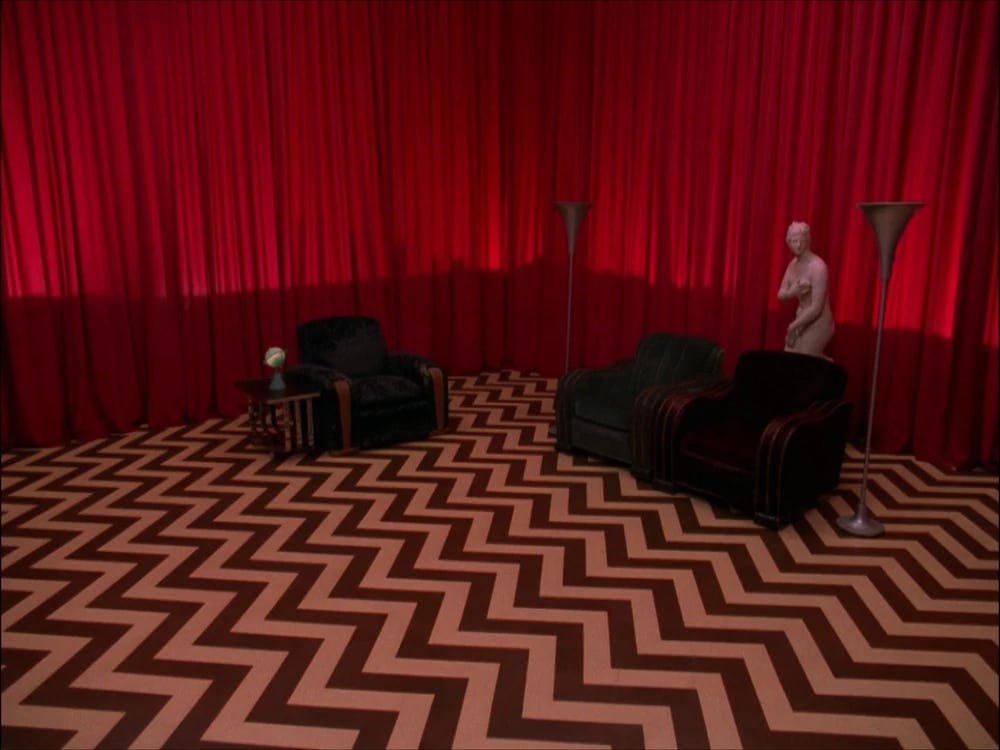
All of Twin Peaks
I have not yet figured out the precise connection, but I feel fairly strongly there is something specific about the experience of being pregnant and the world of Twin Peaks which speak to one another. I had never completely finished watching the original 2 seasons, and while I watched bits and pieces of 2017’s ‘The Return’ with my ex, back then I found it extremely uncomfortable and sometimes even cruel. But in October I started re-watching the first season, and found I couldn’t stop, getting through all three seasons (plus Fire Walk With Me) before the month of October was out. When I tried to figure out why I was watching it so compulsively it again (like The Clock) seemed down to time - the muddled timescale and sometimes sinister irreality of pregnancy kind of perfectly mirrored in Lynch’s magnum opus. If you too are having a weird time and feel like the past and present and future are melting into one, try mainlining Twin Peaks.
Frederick Wiseman
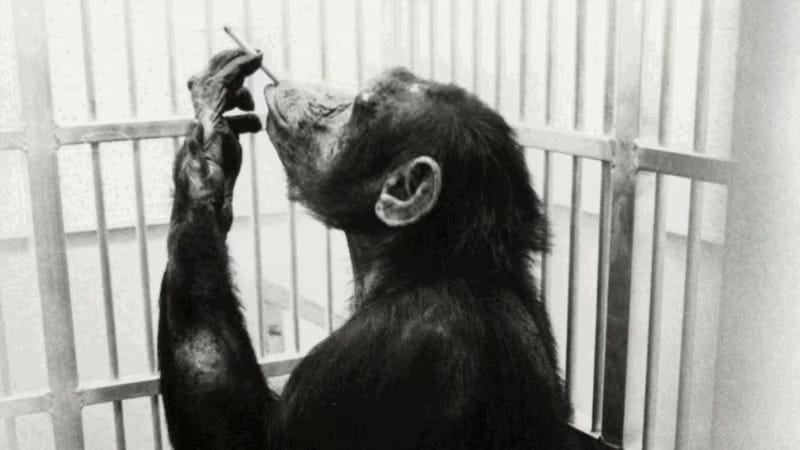
When I was in New York in February there was a retrospective of all of Frederick Wiseman’s documentaries playing at Lincoln Center (an aside, but Film at Lincoln Center is one of the Top 5 things I most miss about living in New York, I lament its absence from my life more often than I can say). They were playing three or four of his enormous corpus of films each day, and a friend and I bought tickets to everything playing one Saturday in an event we dubbed ‘Frederick Wiseman-palooza’. Wiseman’s documentaries are always focused on institutions, organizations, or specific places. Never individuals alone, but rather portraits of how the institutions act as microcosms of society. There is never any commentary, never a talking head. That day in February was, I guess, animal themed, and so we saw, Zoo (1993), Racetrack (1985), and Primate (1974) back to back, the last of which, about an animal testing facility which ends with you staring into the silent, petrified face of a monkey strapped into a machine being launched into zero gravity, I have been thinking about all year. Since then I have been watching Wiseman’s films whenever I can find them streaming, among them High School (1968), In Jackson Heights (2015), and Central Park (1989), the last of which made me weep for some time.
Going to the cinema
I have actively ramped up going to the actual, physical cinema this year, knowing that it’s basically going to be off the cards for me for a while come January, and I saw a lot that came out this year that I really loved, particularly: The Secret Agent by Kleber Mendonça Filho (an incredible portrait of recent Brazilian history), Universal Language by Matthew Rankin (if Kiarostami had made a love letter to the city of Winnipeg), Sorry, Baby by Eva Victor (one of the best portraits of sexual assault and its aftermath I can remember), Peter Hujar’s Day by Ira Sachs (just two friends chatting!), Sound of Falling by Mascha Schilinski (an incredible film about one specific place in rural Germany and the generations of girls and women living in that place over more than a century), and The Mastermind by Kelly Reichardt (the quietest and coziest heist film you’ll ever see).
Listen
Instrumentals for writing
For the last few years, if I have been working in a public space and had recourse to have to use my noise-canceling headphones, I have tended to listen to loops of brown noise. I think I once read it helped you focus a little better? At any rate, it did an okay job of blocking out the infuriating sound of people chatting in libraries. I noticed this year, though, that the brown noise was becoming aggravating, and I hated listening to it. When I was first beginning to write seriously, I would often have music on in the background, and I’m not sure why I stopped. I created a playlist which is entirely instrumental (no voices! voices are the handmaidens of distraction!), but filled with albums and artists which do something to my mind and my emotions that I find incredibly productive when writing. It’s 24 hours long at this point, and skewed my end of year Spotify round-up no end - I was dubbed one of the biggest listeners of Brian Eno, HTRK, Dirty Three, Tim Hecker, and Emahoy Tsege Mariam Gebru, based entirely on this playlist (which is not to say I don’t love those artists in their own right, but my actual taste in music is much wordier!). My point generally is that I feel strongly that listening to music while writing has pushed what I’ve been working on this year in a different direction, one that feels better than the sterile non-space of the brown noise loop.
The radio
I hate Spotify, hate Apple music, all streaming services, basically hate the way I now consume music, and the navel-gazing loops the whole constraining structure necessarily forces me into. The hatred really set in a couple of years ago, when I was no longer working at the bookstore. For most of the 2010s, I discovered new music I loved through the brilliant people I worked with, and the music we would play in the store. But once I left and I was on my own with the streamers, I realised that without that, nothing new (that I liked) was reaching me. I thought back to being a teenager in the 2000s, and the ways I discovered new music back then - I found what I loved through music blog collators like The Hype Machine, Pitchfork, and the radio. The radio was on all the time. The Hype Machine and Pitchfork are shadows of their former selves, but the radio lives on. So a little while ago, we invested in a digital radio which you can program with channels from all around the world. It is one of the best things we have ever bought, and I have, in the last year, discovered nearly everything I’ve loved by cycling through listening to BBC6, NTS, New York’s WFMU, 3RRR in Melbourne, and Three D Radio in Adelaide. I also love what the internationality of the form does to my experience of time - ie, waking up and making coffee on a winter’s Friday morning listening to the ‘getting ready to go out on a summer’s night’ vibe being broadcast simultaneously in Melbourne. Yesterday I happened upon a full half hour of a man playing various Lee Hazlewood songs recorded in languages other than English. Anyway, the radio: great stuff.
Podcasts
I wanted to mention some podcasts I have listened to this year which I have been super impressed with as narrative products, and which I haven’t been able to stop thinking about - the kinds of pieces which 15 years ago would have been books, I think. Including: Time Zero (about the world we all inhabit since the first nuclear bomb was exploded in 1945), When We All Get to Heaven (drawing on archival recordings from an LGBT San Francisco church during the AIDS crisis), The Birth Keepers (a truly terrifying investigation into an extreme free birthing movement), the Gear season of Articles of Interest (about the American military’s influence on fashion), and Gina (Guardian Australia’s series on the richest woman in Australia, Gina Rinehart, and the unbelievable intersection of her life with some of Australia’s worst assaults upon its landscape and First Nations).
That is an impressive amount of work and reading. You have read a great selection of books. I loved Elegy, Southwest. One of my favourite books of the year. I enjoyed McBride's new book but found it a bit disjointed. Her writing style is very unique, modernism takes a bit of getting used to. I picked up Youth a few weeks ago in an antique shop and you are spurring me on to read it soon. I loved his book Disgrace, many years ago. I really enjoyed Theory and Practice, first book of hers I have read. Happy New Year 🎊
Thank you so much for posting! I discovered your writing this year, with a chance encounter of Elegy, Southwest at my local library. Absolutely loved the book, and immediately tracked down a copy of The Inland Sea. Enjoyed that one as well. Still discovering your various essays,etc and enjoying your literary recommendations.
Thank you for what you’ve created so far, and best wishes for 2026 and beyond!