
First Month
Notes from the 31st day of motherhood.

As soon as she is born, they ask us what we want to name her. We look at one another, then say, “we need to talk about it first.” We’d been waiting to see what she looked like. The room is too crowded to have such an important conversation between the two of us.
“What should I put on the paperwork?” asks the midwife, in English.
“Can’t you just write something like ‘Baby Girl Khurana’?” I ask, thinking surely there’s a hospital procedure for not-yet-named babies.
Once the delivery room has cleared out—while we are examining her face, asleep on my chest and still waxy with vernix, blood drying in her fine black hair—we agree that there is only one name on our shortlist that fits. We call out to the midwife, who is standing with her back to us at a computer on the far side of the room, that we have a name now. “Oh no,” she says, “I just pressed send.”
Once we are upstairs in the maternity ward, the nurses begin to comment on our unusual choice of name. We realise the midwife has entered not some German pro-forma placeholder equivalent into the hospital’s system, as I’d expected she would, but the English ‘Babygirl’.
“Babygirl,” the nurses coo to our daughter, until we tell them her real name and a look of relief passes over their faces, relief that we are not the ridiculous Anglophones they had taken us for.
There was a fuck-up with my epidural; everyone is concerned. I am instructed to breastfeed lying flat, my splitting headache is enquired after, I am visited by anaesthesiologists who ask me to press my legs into their hands, evaluating my reflexes (checking whether I’m still neurologically sound, I distantly realise). I am put on heavy painkillers and high-dose caffeine pills. I am not allowed to stand or walk or go to the bathroom unaccompanied; my legs could give way. At first, a nurse helps me to the toilet; then when I’m done, pads my underwear with strips of thick white gauze. The second time I need to go, V helps me to the bathroom. When I stand up, I realize a thick wad of bloodied gauze has fallen into the bright-red water below. “I’ll call a nurse,” I tell him, and he helps me back to bed. Then, before I can press the call button, he goes back into the bathroom, fishes the gauze out of the blood and piss in the toilet bowl, and flushes.
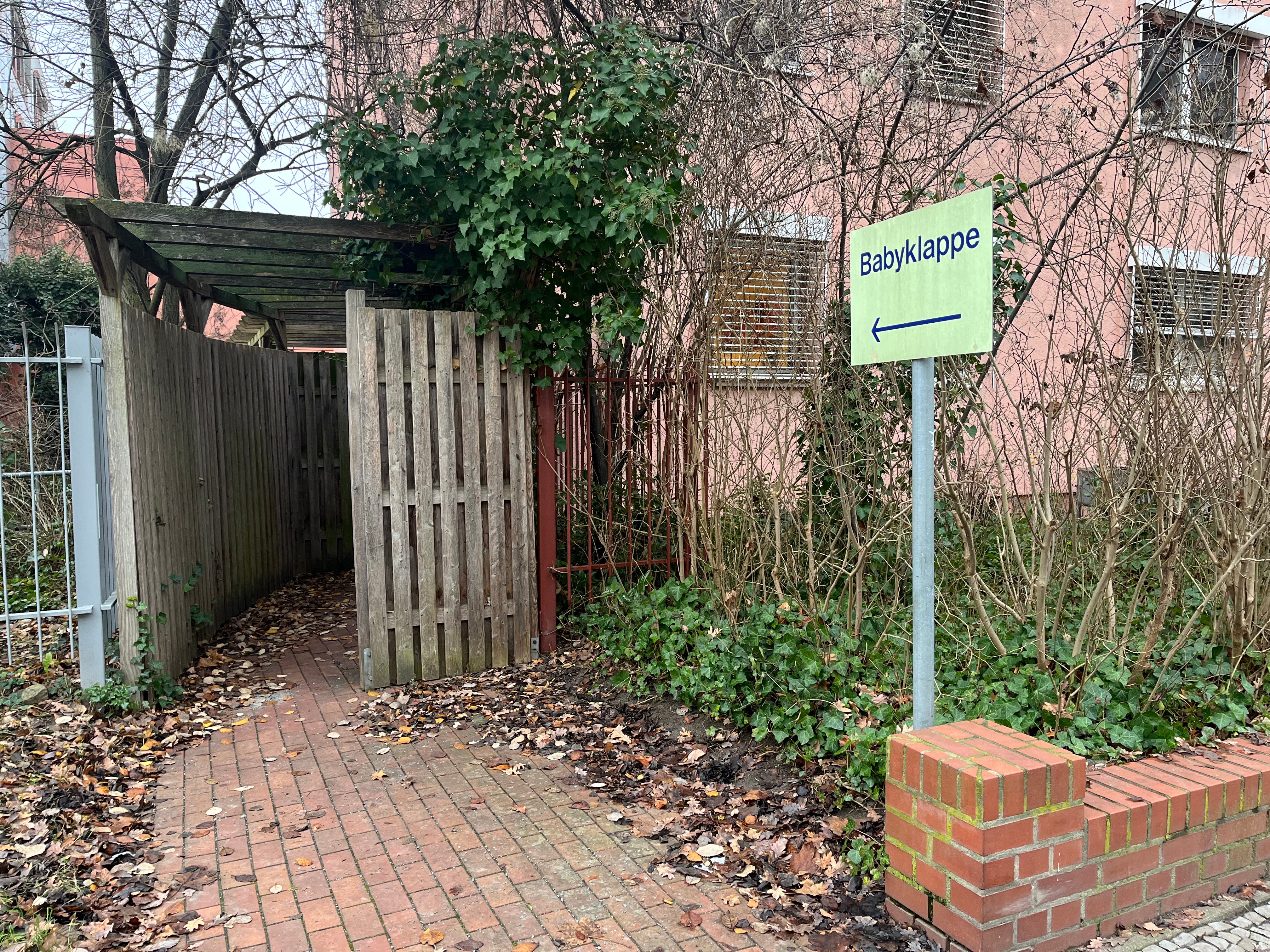
After delivery, we are moved into a family room where we stay for three nights. The room has a double bed, a private bathroom, a crib for the baby, a table and chairs. Tall windows are glazed with something opaque, to let in light without exposing any kind of ‘view.’ One morning, I turn the crank and push one of the windows open, letting the icy breeze in to air out the room. Suddenly I am oriented. For months, since we have been visiting this hospital, we have walked from Südkreuz to this building along a road where a discrete sign points towards a wooden structure shielding what’s inside: a Babyklappe. A vault administered by the hospital where a baby can safely and anonymously be abandoned. Now, from the window of the maternity ward, I can look right down over the vault. Anyone who used it would be perfectly visible to me here, their anonymity shot. Suddenly I am gripped by panic. I close the window and go to the baby, muttering, “I won’t leave you in the Babyklappe.”
Two days after she is born the baby is seen by a paediatrician. She has lost nearly 10% of her birth weight. This is dangerous. I have not yet been able to feed her properly. The baby has barely slept. I have barely slept. We are told we need to stay in the hospital an extra day, and I will have to begin pumping. Later, a midwife wheels in a yellow machine with silicone tubes attached. She hands me a beige spandex band, the kind used to secure the monitors during a CTG, and has me pull it down over my breasts. Then she pinches and pulls, cuts two holes with a pair of scissors, and then positions the holes over my nipples like a piece of cut-rate fetish gear. Suction cups with spouts are placed in the holes, secured by the spandex. I say they make me look like a Fembot in the Austin Powers movies, while V says they remind him of Metropolis. “That’s a higher class of reference,” I say, as the midwife turns the machine on and the pumping begins. It is humbling, humiliating, to be attached to this machine which rhythmically tugs my nipples into the suction chambers and milks me like a cow.
The bizarre feeling of being outside after almost a full week inside the hospital. Walking through the doors of the Kreißsaal with the baby clutched in my arms. They’re just letting me walk out of here, holding a baby! Her face is nuzzled into my cardigan; it is freezing. The pavements are covered in a thick layer of ice, making walking treacherous. She has never been cold before, I think to myself. My stitches strain as we walk to the Miles car we can see available on the app; it’s the most walking I’ve done since giving birth. I sit in the back beside the baby, and we drive home through the wintery Saturday lunchtime of Tempelhof and Schöneberg.
The first night home and I am in bed wearing underpants and a big striped long-sleeved t-shirt. The baby starts crying. I get up to shush her, and while standing by the crib suddenly feel cold drops of liquid spattering on my bare feet. There are wet patches on my shirt. It is milk, flowing out of me in response to her cries.
Incredible to wake up at home, to make coffee, to make yogurt and muesli, to cut up an apple in a bowl and bring it back to bed. To lie with the baby sleeping soundly between us and read.
In the afternoon we are listening to the Magnetic Fields’ 69 Love Songs. While I watch V change the baby on the other side of the room I am suddenly overwhelmed with happiness at my good fortune. I begin to sob. He hands me the baby and sits beside me on the bed as the music keeps playing. A lyric to the song ‘Abigail, Belle of Kilronan’ suddenly strikes me as incredibly meaningful. I am laughing through the sobs as I try to explain to V: “I want her to live always in a world of love.” Never before has a cliché felt so profound.
What I hadn’t anticipated: the bright red blood coming out of me for almost a week, so different in colour to menstrual blood, and of an almost gelatinous texture. The enormous postpartum pads I use to sop it up. The pads I stick into my bra to absorb the breast milk. The powerful scents I can smell on myself as I undress to get into the shower - the tang of drying blood, the sourness of milk.
I am becoming forgetful. One of the midwives at the hospital warned us it would happen. She said I was filled with oxytocin, which makes you happy, and makes you forget about the agony of childbirth so that you’ll have more children. This morning I forgot to take my thyroid medicine. I’ve forgotten twice this week. Before now, I’d forgotten to take it maybe five times in five years. V suggested it’s the sleeplessness. But I have chronic insomnia, I countered, and that’s never made me forget to take my medication. This forgetting feels entirely different, something bound up with the biology of becoming a mother.
Blake texts us and asks if we saw the aurora borealis over Berlin last night. He sends pictures of brilliant lights in the dark Prenzlauer Berg sky. No, we didn’t see it. We didn’t see a thing. I realise I don’t know when I last looked out the window.
After feeding the baby at lunchtime I put her on my chest and we sit companionably together during these rare hours when she is awake and keen-eyed and calm. I take up a volume of poetry from the shelf by my bedside — Marilyn Hacker — and begin to read poems aloud to the baby. I come to the poem “Nearly A Valediction,” and its opening lines: “You happened to me. I was happened to/like an abandoned building by a bull-/dozer”. I can hear my own voice catch as I continue reading aloud.
“While I love somebody I learn to live/with through the downpulled winter days’ routine/wakings and sleepings, half-and-half caffeine-/assisted mornings, laundry, stock-pots, dust-/balls in the hallway, lists instead of longing, trust/that what comes next comes after what came first./She’ll never be a story I make up.”
At that last line my voice catches and tears begin streaming down my face. The simple truth of the line feels overwhelming. Before now, I had spent a whole life - from childhood – idly imagining my future daughter, imagining all the possible permutations of a child I might one day have, the way she would look, the things we would do together, and I imagined this child even when I wasn’t sure I wanted to have children. She existed always as a possibility, a potential future. And now here she is, specific and individual, no longer imaginary but material, absolute.


My waist reappears. Before bed I trace the curve from hipbone down into the dip below my rib cage. I ask V to feel it. “I can nestle my arm in there again,” I say, demonstrating.
During the night V is changing yet another dirty nappy, and in the middle of the procedure the baby pees everywhere, all over his hands and her clothes and the mat below. I am in bed, watching.
“Isn’t it interesting,” I say, taking a sip from my water bottle, “that water I drink eventually comes out as pee from her body.”
V, harried and distracted: “My love, I have other things on my mind.”
I finish reading Boulder by Eva Baltasar. A novel narrated by a Spanish woman whose Icelandic girlfriend decides after many years together that she wants a baby, and what happens to their relationship once the baby arrives. In the afternoon, I try to explain to V how I felt about it. On the one hand, there were incredibly beautiful sections on desire, rendered in gorgeous prose. But I found the novel deeply depressing as well. The Icelandic girlfriend is wild and smart and deeply desirable, up until she wants a baby. Pregnancy others her. On the other side, she is depicted as increasingly ridiculous, joining mother-baby swim classes that purportedly help babies breathe underwater as they did in the womb, hosting breastfeeding parties where women sit in a circle with their infants and feed together. The narrator resents her, begins an affair with a younger woman. In the end, coming home to confess the affair to her girlfriend, she opens the door to a scene of her girlfriend’s own infidelity. The girlfriend is on her knees, going down on another woman from the breastfeeding group, who is in the act of feeding her child, pressing the baby’s head into her breast as her orgasm approaches. The scene was revolting, I told V, utterly abject. “That sounds really powerful though,” he said, “it’s a very unsettling image.” It was clearly effective as a piece of writing, he pointed out, because it had so disturbed me. Which was true, I acknowledged, it was good writing in that respect. What bothered me was the way the scene acted as the culmination of a particular attitude to pregnant and postpartum women – revolting and ridiculous. It reinscribed precisely the same kind of images and attitudes to be found in the work of twentieth century male writers (Bellow, Roth, Updike). That the couple in the novel was composed of two women, that the novel itself was written by a woman, had no real impact; the pregnant and postpartum woman was still being used as narrative device to represent the death of reason and desire. She was still fundamentally alien, irrational, and abject.
At night the baby feeds every three to four hours. The alarm goes off and we wake her up; usually she is already stirring. In the night I feed her in my mouth guard, eye mask pushed up on my forehead and hair puffing out like soufflé over the elastic, V in trackpants, slippers, headphones dangling around his neck. Feeding her with one eye open, one of us always reporting to the other on the last three hours of updates to the Guardian. No mention of Iran or Greenland or Minneapolis, we can bear only mindless football and pop culture news, or ‘Experience: a bear moved into my house’ or some curiosity of Australian news, like a jellyfish bloom in Port Phillip, the final V-set trains riding the Lithgow line. V asks me who Sabrina Carpenter is. I know so much about the Premier League now. The baby feeds, 20 minutes, sometimes longer, then he takes her to burp, although sometimes she doesn’t. But soon she is writhing in intestinal pain. I have developed a fear of that red open mouth, the agonised gums, small rigid tongue. That line of Sylvia Plath’s about her baby in ‘Morning Song’: “Your mouth opens clean as a cat’s”. Then the screams begin. Inconsolable and somehow shocked, affronted by the experience of being embodied (how often when I was pregnant I considered that until she exited my body, she would have never once experienced pain). We take turns holding her, rocking her, walking her, draping her across a knee and rubbing her back, until eventually she falls into a kind of sleep on my chest or in the crook of my arm, and I lie there, not moving, until she is asleep enough to be placed back in the crib without waking, and we see the phone’s timer saying we have less than 2 hours to go until we do it all again.
Lex drops by after work, bearing a green and cream striped newborn onesie from DM and three big tubs of food. They have been making extras of their own dinners and freezing them for us - a Bolognese, a lamb curry, a Vietnamese crab soup she tells us to warm up very slowly. I almost cry.
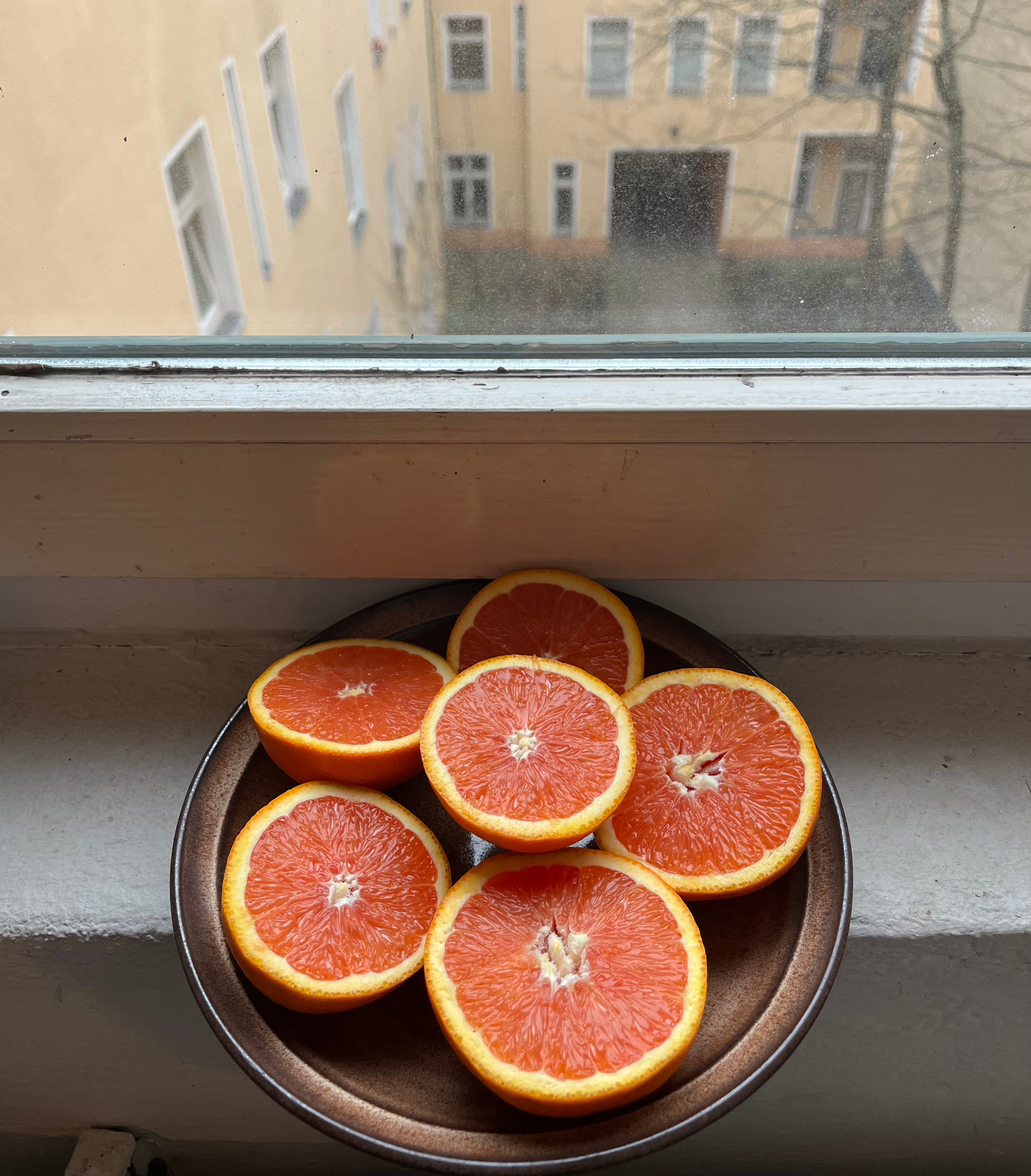
Things I want to remember: the baby was born into blood orange season. She was born into the coldest Berlin winter in sixteen years. She was born at 4.49am, while it snowed.
I had forgotten about the photobook copy of My Birth by Carmen Winant sitting on the bookshelf in the living room with all my other art books, even though it’s been directly opposite the couch where I’ve spent so much of the last few months. When I opened it again today it occurred to me that the images would have frightened me if I’d looked at it again while pregnant. Now, it strikes me as almost mystical. These images of women in agony, exhaustion, euphoria – I can feel them in my body now in the way I simply couldn’t when I bought the book eight years ago (or did I get it free, damaged, from McNally Jackson when I worked there?)
I underline a quote from Margaret Atwood’s short story ‘Giving Birth’, which Winant includes in her brief text:
“But who gives [birth]? And to whom is it given? Certainly it doesn’t feel like giving, which implies a flow, a gentle handing over, no coercion...No one ever says giving death, although they are in some ways the same, events, not things. And delivering, the act the doctor is generally believed to perform: who delivers what? Is it the mother who is delivered, like a prisoner being released?...How can someone be the sender and receiver at once? Was someone in bondage? Was someone made free? Thus language, muttering in its archaic tongues of something, yet one more thing, that needs to be re-named.”
I’m sitting at the table paging through the book’s images while V eats lunch. Images of slick hairy heads emerging from between legs, flesh ruptured. I still find it difficult to understand that that’s what happened to me. How much space was made – what was giving, and what was giving way. How much of what I am or was split or shattered to let forth a life.
I show V the pages of the book, asking, “is this what it looked like?”
He nods. “Yeah, that’s what it looked like. Although,” he qualifies, “I was standing up by your head, I had a different angle on it.”


Across the street somebody has written ‘sexy mama’ with a finger into the snow that’s settled on the bonnet of a parked car.
The German word for ‘childbirth’ or ‘delivery’ is Entbindung. “When was the Entbindung?” I am asked on the phone while booking a postpartum doctor’s appointment. The related verb is entbinden. Release, let go, disengage. To unbind. In this sense, in German, birth is the unbinding of baby from maternal body, a release. There is a sadness to Entbindung, a sense of loss, that isn’t there when I use the equivalent words in English.
I bop the baby on my hip in time to music playing on the radio - ‘Do You Realise’ by the Flaming Lips, a live rendition of ‘Sara’ by Fleetwood Mac, ‘Let’s Dance’ by David Bowie. An incredible look of concentration appears on her face - she doesn’t stir or make a sound, but she is alert, all big eye and O-mouth. She likes best men with baritone voices: Nick Cave, Tom Waits, Jack Ladder. I dance or sway in place, trying to maintain a beat in my body that she can feel. My own body is affronted. All the underused parts of myself - my jellied core, my wobbly lower back, the heavy, aching pelvic floor; my whole body strains with the dance.
I am surprised by how disappointed I am in myself for not writing when she sleeps. For being as exhausted as I am. As though somehow I thought I would be different, not like everyone else who talks about how hard these early weeks are. There is the fear of losing my creative self, the self who writes.
The baby often sleeps with her arms raised above her head, her hands in fists, as though she is celebrating having won a big race.
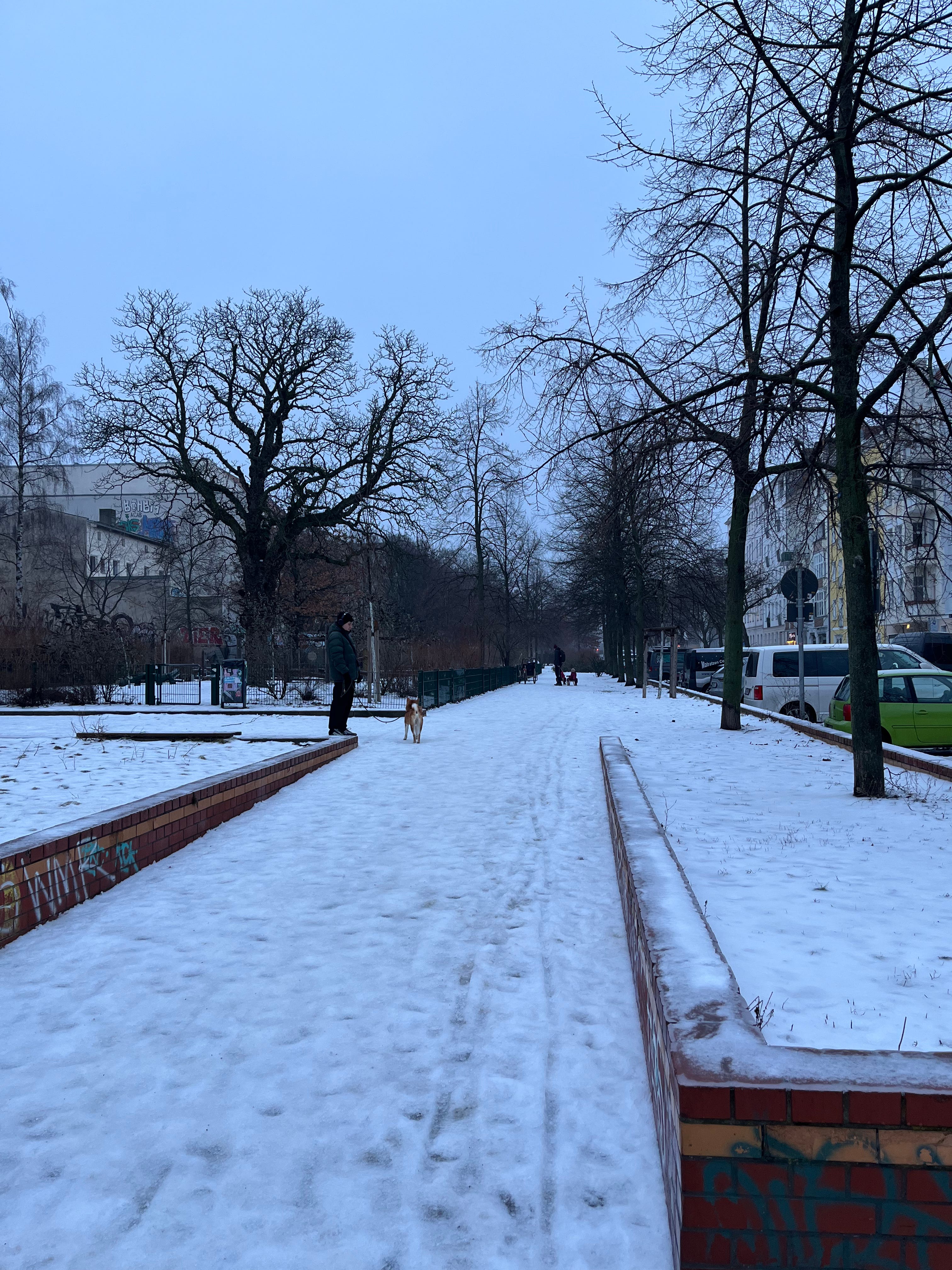
Thick falls of snow, glowing and guiltless when seen from the windows at 4 and 5 and 6 in the morning when rinsing out the nipple shield in the kitchen, rocking the baby as the cries. Snow collected on the red roof tiles of the old building housing the boxing gym on Prinzenallee, and the brown roof tiles of the building across the street, snow collected in the skeletal arms of the naked maples. Hours later, when I am eventually ‘awake’, the new snow is sullied, brown with tyres and footfall, black with the scrim of exhaust.
In the afternoon, once we are home from our walk around the neighbourhood, I feed the baby in bed while V warms soup, brings it to bed to eat, sets up his laptop on the duvet between us, and streams the first day of the Winter Olympics coverage. The 3000 metre women’s speed skating is on. We watch them race two by two. V finishes his meal and goes back to work, but I keep watching. First place is in close contention. Towards the end, an Italian woman races, all dyed blonde hair and fluro green nails. The crowd is wild for her. The commentators say that it’s her 35th birthday today, and that before this Olympics she had given interviews saying she wasn’t sure if she would do another one; she could either train for another Olympics or have a baby. In the end she did both. The expected champion races last, but she is not good enough, she comes fourth, and the Italian woman, green nails tented over her mouth and nose, releases her hands and cries with delight when she realises she’s won. She races out of the competitor’s area, and the camera follows her under a tunnel and up to the audience, where a friend or sister is waiting with a small boy - the woman’s two-year-old son- in her arms. The Italian speed skater grabs him, kisses him all over, and races back through the tunnel. I am trying to soothe the baby, who is grumbling after feeding, but I am watching this woman and her little boy - her first instinct being to find him and hold him in her moment of victory - and I begin to cry. Have I ever been so moved by the sentimental as I have been this month?
I still have blood glucose test strips on top of the fridge. I still have chilled heparin shots in a Ziploc bag behind a jar of tamarind paste and a packet of stringy Turkish cheese. I put on the black Everlane skirt I bought in extra-large last summer, and wore all the time in the third trimester - it is vastly too big around the waist, but what clothes do I wear now, in this new life? Last night in the shower I looked down and realised I could see my crotch beneath the curve of my stomach for the first time in months. Which also means I can see properly now the extent of the stretch marks. When will the stretch marks start to fade? When do I throw away the skirt and the test strips and the heparin? Throwing them away would feel so final, so decisive. A declaration that I don’t need them anymore; that I’m not pregnant.
We are summoned to the Standesamt in Schöneberg to collect the baby’s birth certificates. It is the first time we take her out in the pram, the first time we take her on the U-Bahn. She is wrapped up in a pink blanket knitted by my mother, dressed in a blue, boiled wool onesie and a hat that falls down over her eyes. After we’ve collected the certificates, we park the pram outside the entrance to the bathrooms, discussing which one of us will change her. A woman walks by and stops, coming to peer over my shoulder and coo at the baby. She asks how old the baby is, says how sweet, and how beautiful.
“Ein Junge?” she asks.
“Nein,” I say, “ein Mädchen.”
“Ein Mädchen”, she repeats, shocked. “Mit Blau?” she asks, nodding at the blue wool suit.
“Ja, mit Blau” I confirm, and the woman walks off into the ladies’ bathroom, shaking her head, as though she’d never heard of such a thing before.
For the first time, I leave the apartment alone and get the S-bahn to Brandenburger Tor. I have not been anywhere without the baby since May – since I found I was pregnant, I have never gone anywhere, really, alone. I feel shaky, surreptitious, like I have a secret. Much the same way I felt in the first trimester. These people don’t know I have a baby at home, I think as I look at the other passengers riding the S2. And then I reach for my phone, open up the Photos app, and swipe through the countless pictures I have taken of my daughter until the train reaches my stop.
I'm reading this about 30 weeks pregnant (read Mama Tried on Baffler, too, today) and hanging on to your every word! Your experience as you've shared it is resonating with me deeply. Thank you for your writing
my congratulations - I was at your reading with V and Gabriel Flynn a while back when visiting Berlin, when you were still expecting (or is that term out of use now?) ‚Entbinden‘ doesn‘t reflect that there is simultaneously a new tie appearing, or actually two when both parents are involved. I hope ‚babygirl‘ will do well in this word.